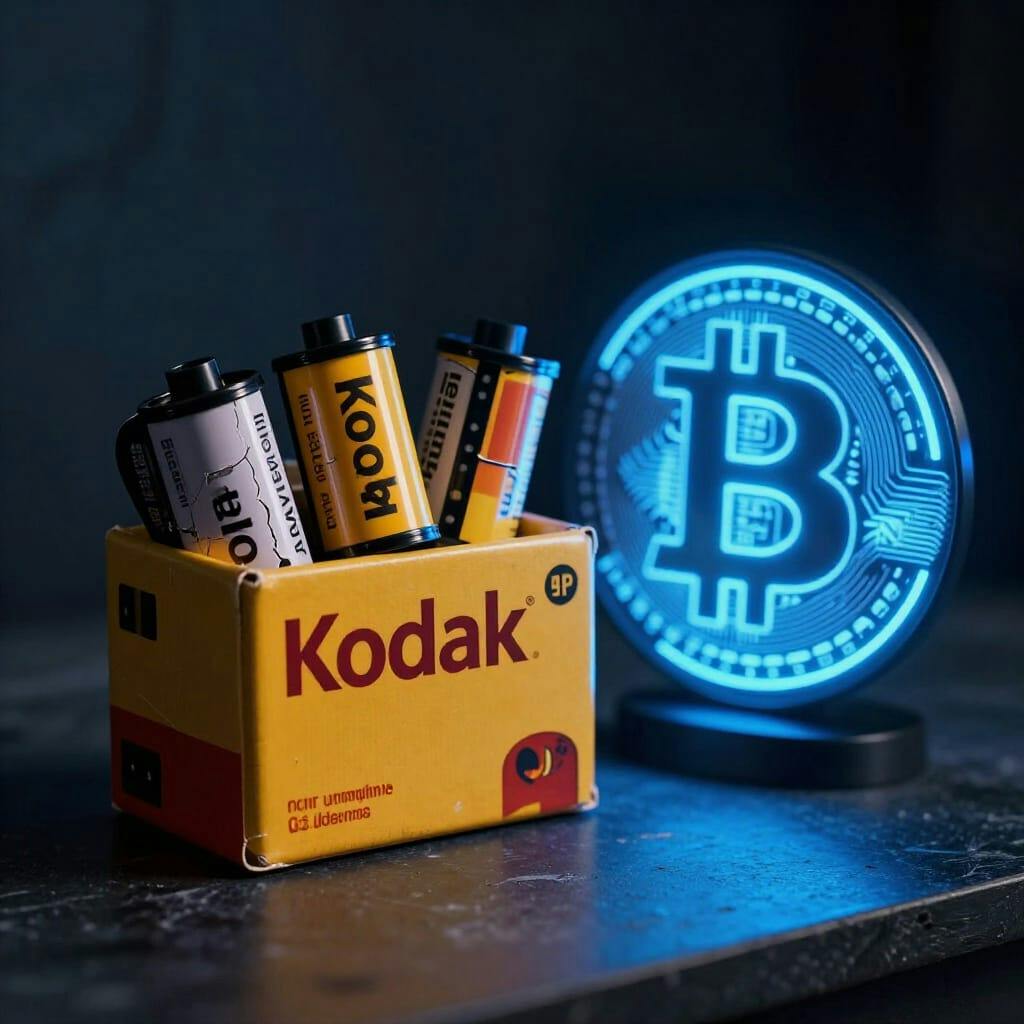

When Laughter Reveals Everything You Need to Know At the World Economic Forum in Davos this week, the French Central Bank Governor laughed. Not a polite chuckle, but an audible dismissal i.e. the kind of laugh that reveals someone hasn't taken the time to understand what they're dismissing. The subject? Bitcoin's potential to compete with fiat currency. His laughter wasn't unique. It echoed through the alpine halls where the architects of the current financial system gather annually to discuss how that system should work. But history has taught us that such laughter is rarely the sound of confidence. More often, it's the sound of an incumbent who hasn't yet been forced to take a threat seriously. And I've heard that laugh before. In boardrooms at Kodak. In executive suites at Blockbuster. In strategy meetings at Nokia. It's the laugh of someone who believes their moat is permanent, their position unassailable, their understanding complete. They're always wrong. The Photo CD Parallel - When Innovation Serves The Old Model In my previous piece, "Fiat Can't Respond to a Community's Values and Needs, But Bitcoin Does," I explored how centralized monetary systems fail to adapt to community needs. But watching Brian Armstrong, CEO of Coinbase, patiently explain Bitcoin's fundamentals to a central banker who clearly hadn't done his homework revealed something even more profound i.e. central banks aren't just resistant to Bitcoin, they're repeating one of history's most spectacular corporate failures. Fiat Can't Respond to a Community's Values and Needs, But Bitcoin Does Fiat Can't Respond to a Community's Values and Needs, But Bitcoin Does Let me take you back to 1990. Kodak, the undisputed king of photography, stood at a crossroads. Digital photography was emerging, and, ironically, Kodak had invented the first digital camera back in 1975. They had fifteen years to prepare. They had the patents, the technology, the brand recognition, and the market dominance. They had everything except the courage to cannibalize their own business model. So instead of embracing the digital revolution they had pioneered, Kodak launched Photo CD. Photo CD was Kodak's compromise solution, a way to enter the digital age without abandoning film. Customers would still shoot film, still develop film, but then their photos would be scanned onto a proprietary CD format that could be viewed on special Photo CD players. It was digital, technically. But it was digital on Kodak's terms. Digital that still required film. Digital that still generated revenue from Kodak's existing infrastructure. The format was technically impressive. It used a sophisticated color space, multiple resolutions, and even some "super white" information that resembled primitive RAW files. Professional photographers appreciated the quality. But there was one problem i.e., it was a solution designed to preserve the old system, not to embrace the new one. Photo CD required proprietary players ($400 each). It used a format that would later become "orphaned" when Kodak abandoned it. Most damningly, it solved yesterday's problem while the world was already moving toward tomorrow's solution i.e. true digital cameras that eliminated film entirely. By 2004, processing labs were offering to pay people to haul away their Kodak 4050 Photo CD scanners. By 2012, Kodak filed for bankruptcy. CBDCs - The Photo CD of Money Now let's talk about Central Bank Digital Currencies (CBDCs). Just as Kodak invented digital photography but refused to fully embrace it, central banks understand that money is going digital. They've watched Bitcoin operate flawlessly for sixteen years. They've seen stablecoins gain adoption. They've witnessed the rise of decentralized finance. They know change is coming. So what's their response? CBDCs, digital currency on their terms. Digital currency that preserves central control. Digital currency that maintains the existing power structure. Like Photo CD, CBDCs are technically sophisticated. They could offer faster payments, programmable money, and improved financial inclusion. Central banks cite these benefits constantly. But scratch the surface, and you'll find the same fundamental flaw that doomed Photo CD, i.e. CBDCs are designed to preserve the old system, not to embrace the new paradigm. Consider what CBDCs actually represent: Centralized control over a decentralized technology Surveillance capabilities that would make physical cash obsolete Programmable restrictions on how you spend your own money Elimination of financial privacy under the guise of fighting crime The same trusted intermediaries in a world that's discovering the value of trustlessness Centralized control over a decentralized technology Centralized control Surveillance capabilities that would make physical cash obsolete Surveillance capabilities Programmable restrictions on how you spend your own money Programmable restrictions Elimination of financial privacy under the guise of fighting crime Elimination of financial privacy The same trusted intermediaries in a world that's discovering the value of trustlessness The same trusted intermediaries Even the Federal Reserve has quietly acknowledged that CBDCs are "a solution in search of a problem" in countries like the United States, where digital payment systems already work efficiently. But the most revealing parallel isn't in the technology, it's in the psychology. Just as Kodak's management couldn't imagine a world where people wouldn't need film, central bankers can't imagine a world where people don't need Fiat money. The French Central Bank Governor's laughter at Davos stemmed from the same place as Kodak's dismissal of digital cameras i.e. "This threatens our business model, therefore it must not be serious." When Brian Armstrong Met the Status Quo The exchange at Davos deserves to be studied in business schools as a case study in how incumbents fail to recognize disruption. Let me walk you through it. Armstrong made a straightforward point i.e. the current fiat system was only created in 1971 when Nixon abandoned the gold standard. Before that, money had some connection to hard assets. Now, democracies worldwide struggle with fiscal discipline, running persistent deficits that cause inflation. Bitcoin represents a return to "sound money", money with a fixed supply that can't be debased. The French Central Bank Governor's response was telling i.e. "Money is part of sovereignty... if we lose that really you lose a key function of democracy." Think about that framing. Not "money is a tool for economic efficiency." Not "money is a neutral medium of exchange." But "money is part of sovereignty", a blunt admission that central banks view money as a tool of state power. When Armstrong pointed out that Bitcoin is even more independent than central banks, having no issuer, no board, no political pressure, no emergency powers, the Governor laughed. Not because Armstrong was wrong. He laughed because Armstrong was so obviously right that it threatened the entire conceptual framework the Governor operates within. The Governor then claimed to trust "independent central banks with a democratic mandate" more than "private issuers of Bitcoin." This revealed a complete misunderstanding of what Bitcoin is. Bitcoin has no issuers, private or otherwise. It's a decentralized protocol. The fact that a central bank governor doesn't grasp this basic point while dismissing Bitcoin is like Kodak's leadership not understanding how a digital sensor works while dismissing digital cameras. It's not confidence. It's ignorance dressed up as authority. The Pattern Repeats Itself Here's what Kodak's leadership didn't understand i.e. you can't compromise your way through a paradigm shift. You can't preserve the old system while pretending to embrace the new one. The market eventually forces you to choose, and by the time you're forced to choose, it's usually too late. Kodak tried to have it both ways with Photo CD. They tried to preserve film while going digital. They failed. Central banks are trying to have it both ways with CBDCs. They're trying to preserve centralized monetary control while going digital. They will fail for the same reason. The pattern is remarkably consistent across industries: Kodak's thinking: "People will always want the quality and familiarity of film. We'll give them digital as an add on to their film workflow." Kodak's thinking: Reality: People wanted the convenience, cost savings, and creative freedom of pure digital photography. Film became a niche product for enthusiasts. Reality: Central banks' thinking: "People will always need the stability and legitimacy of state backed money. We'll give them digital currency with all the benefits of crypto, but with trusted institutions still in control." Central banks' thinking: Reality: People are discovering the benefits of money that can't be debased, can't be seized arbitrarily, can't be inflated away, and doesn't require permission to use. Fiat is becoming a depreciating medium of exchange while Bitcoin becomes a store of value. Reality: Why This Time Really Is Different The central bankers at Davos would argue that governments have power that Kodak never had. They can regulate. They can ban. They can use the force of law. They're right, of course. But this misses the point entirely. Kodak didn't fail because they lacked power over their customers. They failed because the underlying technology shifted, and the old business model became obsolete faster than the old company could adapt. No amount of market power can protect you when the market itself is changing. Money is undergoing the same fundamental shift. For thousands of years, money required a trusted intermediary, someone to mint the coins, someone to issue the notes, someone to validate the ledgers. Trusted intermediaries meant centralized power. Centralized power meant the ability to debase, confiscate, and control. Bitcoin changed the equation. For the first time in human history, we have money that works without trusted intermediaries. Money that's globally accessible, cryptographically secure, provably scarce, and resistant to seizure or debasement. This isn't an incremental improvement. This is a fundamental change in what money can be, as fundamental as the change from analog to digital photography. Central banks launching CBDCs is like Kodak launching Photo CD. It's an admission that change is happening, coupled with a desperate attempt to control that change rather than embrace it. It's innovation in service of preservation. It won't work. The Choice We Face There's a reason Brian Armstrong stayed calm during that exchange in Davos. He wasn't trying to convince the French Central Bank Governor. You can't convince someone whose salary depends on not understanding. Armstrong was speaking to everyone else. To the entrepreneurs building on Bitcoin. To the investors watching capital flow. To the citizens of countries experiencing monetary mismanagement. To anyone willing to think independently about what money should be. The choice is binary, and it's the same choice photography faced: Photo CD or digital camera? Photo CD or digital camera? Proprietary format that preserves the old model, or open standard that enables the new one? CBDC or Bitcoin? CBDC or Bitcoin? Programmable money that enhances state control, or programmable money that enhances individual sovereignty? Managed decline or creative destruction? Managed decline or creative destruction? The comfortable illusion that we can preserve the old system with new technology, or the uncomfortable truth that paradigm shifts don't ask permission? The Laughter Will Stop In 1990, when digital cameras started appearing, Kodak executives dismissed them. The resolution was too low. The workflow was too complicated. Customers loved film. The barriers to entry in film manufacturing protected them. They were right about all of those things in 1990. They were catastrophically wrong about where things were headed. In 2026, when Bitcoin crossed $100,000 and central banks started taking it seriously enough to issue CBDCs, many of those same central bankers laughed at the idea that Bitcoin could compete with fiat currencies. The volatility was too high. The user experience was too complicated. People trusted government money. Legal tender laws protected them. They're right about some of those things today. But they're missing the direction of travel. Photo CD worked, technically. But it was solving the wrong problem. It was trying to make the transition from analog to digital while keeping the analog infrastructure intact. CBDCs will work, technically. But they're solving the wrong problem. They're trying to make the transition from centralized to decentralized money while keeping the centralized power structure intact. The market doesn't care about your compromise solutions. The market cares about what works better for users. And just as digital cameras worked better than film + Photo CD, Bitcoin works better than fiat + CBDCs for anyone who values: Scarcity over infinite money printing Permission-less access over gatekeepers Transparency over opaque monetary policy Sovereignty over surveillance Code over trust Scarcity over infinite money printing Scarcity Permission-less access over gatekeepers Permission-less Transparency over opaque monetary policy Transparency Sovereignty over surveillance Sovereignty Code over trust Code The Verdict Is Already In Here's the thing about paradigm shifts i.e. by the time the old guard realizes what's happening, the new paradigm has usually already won. The lag time between "they're laughing at us" and "they're fighting us" and "we won" can feel glacially slow when you're living through it. But from a historical perspective, these transitions happen remarkably fast. Kodak filed for bankruptcy in 2012, just 22 years after launching Photo CD. The company that had dominated photography for over a century was gone in a generation. How long will it take for central banks to realize that CBDCs are their Photo CD moment? That they're building sophisticated technology to preserve an obsolete system? That the laughter in Davos was the sound of people who haven't yet realized they've already lost? I don't know. But I do know this i.e. the French Central Bank Governor's laughter will stop. Just like Kodak's dismissiveness stopped. Not because Bitcoin convinced them, but because the market made their opinion irrelevant. But here's what makes this paradigm shift different from Kodak's fall and ultimately more inevitable: Money is about people. Money is about people. Photography was about capturing moments. When digital cameras proved superior, professionals switched, then enthusiasts, then everyone else. It was a technological transition driven by better tools. But money? Money is about us. About our labor, our savings, our future, our families, our freedom. And the uncomfortable truth that people are beginning to understand is this i.e. fiat currency was never designed with them in mind. us fiat currency was never designed with them in mind. Fiat was designed for governments to fund wars without immediate taxation. It was designed to allow deficit spending without political accountability. It was designed to transfer wealth silently through inflation from savers to debtors, from citizens to states. It was designed to give central planners the power to manipulate economic behavior through monetary policy. These weren't bugs. They were features. Features that benefited those who control the system at the expense of those who simply use it. When people truly internalize this, when they understand that their purchasing power declining isn't an unfortunate side effect but an intended outcome, that their savings being debased isn't bad luck but policy, that their financial privacy disappearing isn't about safety but about control, they don't just switch technologies. They switch paradigms. And that paradigm points directly to Bitcoin and crypto. Not because Bitcoin is perfect. Not because crypto solves every problem. But because for the first time in modern history, people have a choice. They can opt into a monetary system that's: Designed for them, not for governments Transparent in its rules, not subject to political whims Limited in supply, not infinite in creation Accessible to anyone with internet, not controlled by gatekeepers Sovereign at the individual level, not the institutional level Designed for them, not for governments Designed for them Transparent in its rules, not subject to political whims Transparent Limited in supply, not infinite in creation Limited Accessible to anyone with internet, not controlled by gatekeepers Accessible Sovereign at the individual level, not the institutional level Sovereign The question isn't whether CBDCs or Bitcoin will win. That question was answered the moment Bitcoin proved that money could work without centralized control, just as digital cameras proved that photography could work without film. The only question is how long it takes everyone else to realize it. And critically: how many people need to wake up before the paradigm shifts irreversibly? how many people need to wake up before the paradigm shifts irreversibly? History suggests the answer is i.e. not as many as you think. Technological adoption follows an S curve. It seems slow, then suddenly it's everywhere. We're still in the "slow" phase where central bankers laugh. But every person who studies Bitcoin for their 10,000 hours, every business that adds it to their treasury, every country that accumulates it as a strategic reserve, they're not going back. You can't un ring this bell. And whether you're positioned on the right side of history when enough people wake up to the truth about fiat currency determines more than your portfolio returns. It determines whether you saw the paradigm shift coming, or whether you laughed at it like a French central banker in Davos. As my previous article argued, fiat systems can't respond to community values and needs the way Bitcoin can. But this goes deeper. Central banks can't even respond to their own obsolescence. They're too invested in the old system to imagine the new one. As my previous article argued, fiat systems can't respond to community values and needs the way Bitcoin can. But this goes deeper. Central banks can't even respond to their own obsolescence. They're too invested in the old system to imagine the new one. Kodak invented the digital camera and went bankrupt anyway. Central banks understand blockchain technology and will lose their monopoly anyway. Kodak invented the digital camera and went bankrupt anyway. Central banks understand blockchain technology and will lose their monopoly anyway. Some patterns in history don't just rhyme. They repeat exactly. Some patterns in history don't just rhyme. They repeat exactly. And they always end the same way. And they always end the same way. The difference this time? Money is about people. And people are waking up. When they realize fiat was designed to benefit the system, not them, they won't just adopt new technology. They'll shift the entire paradigm. The difference this time? Money is about people. And people are waking up. When they realize fiat was designed to benefit the system, not them, they won't just adopt new technology. They'll shift the entire paradigm. That paradigm points to Bitcoin and crypto. That paradigm points to Bitcoin and crypto. The only question is whether you'll be laughing in Davos or whether you'll be ready. The only question is whether you'll be laughing in Davos or whether you'll be ready. Let's Go!