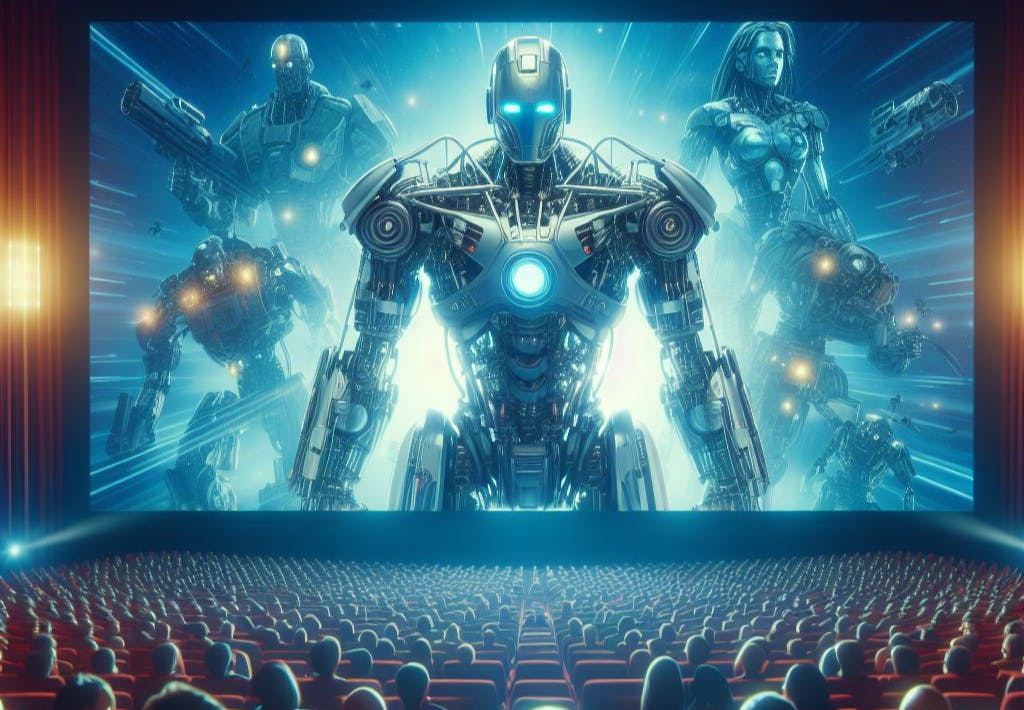
Most futurists and science fiction writers, when touching on the topic of artificial intelligence, analyze the hypothetical dangers associated with the emergence of what is broadly referred to as Super AI or superintelligence. The idea is that in developing general-purpose artificial intelligence, our civilization will sooner or later cross the threshold of what is called the "singularity" — the point at which AI becomes self-aware as a personality. It is expected that, processing information faster than the human brain, possessing memory encompassing at least all publicly available electronic databases, and equipped with self-learning capabilities, such an AI will claim the position of the most advanced intelligence on Earth, relegating humanity to second place. What follows, in science fiction and futurology, typically boils down to five alarmist scenarios and their combinations: Super AI attempts to exterminate humanity Super AI attempts to enslave humanity Super AI manipulates people, leaving them the illusion of independent decision-making while actually using them to carry out its own plans and goals Super AI seizes power, keeping humans in the position of small children or domestic pets Super AI goes out of control, focusing on its own objectives and completely ignoring the interests of humanity Super AI attempts to exterminate humanity Super AI attempts to enslave humanity Super AI manipulates people, leaving them the illusion of independent decision-making while actually using them to carry out its own plans and goals Super AI seizes power, keeping humans in the position of small children or domestic pets Super AI goes out of control, focusing on its own objectives and completely ignoring the interests of humanity Such concerns have little to do with reality — and here is why. Even the most extraordinary processing speed and a vast volume of stored information will not make AI "smarter" than a human in any meaningful sense. Intelligence is not simply a matter of data throughput. Human thinking is inseparable from the body, from emotion, from lived experience — from everything that shapes not just computational power, but a personality with motives and desires. AI, however powerful, is a different kind of intelligence — neither better nor worse than ours, but fundamentally unlike it. The key question here is not "how intelligent is it?" but "what does it want?" And the honest answer is: we do not know. It is entirely possible that a strong AI will want nothing at all — in which case, every apocalyptic scenario simply loses its driving force. In any case, a strong general-purpose AI will not be human and, as a consequence, will not behave like a human. Which means the realization of all the negative scenarios listed above is extremely unlikely — simply because they are based on attributing human desires and ambitions to artificial intelligence. Even the "Ignore" scenario is too distinctly human in nature. We spend far too much time discussing the risks associated with creating strong AI, and almost no time asking what will happen if we fail to create it. Do you remember the legend of the Gordian Knot? As a brief reminder: "Once upon a time, the king of Phrygia, Gordius, tied an extraordinarily complex knot, prophesying that whoever managed to untangle it would become ruler of all Asia. Many tried to undo the legendary knot, but only Alexander the Great succeeded — though not by untangling it, but simply by cutting it with his sword." It is generally held that this story symbolizes Alexander's decision to seize power over Asia by purely military means, without even attempting to work through the tangled relationships between its kings, satraps, peoples, and religions. Unfortunately, this legend — viewed more broadly — symbolically describes not an isolated historical episode, but a dark tradition of humanity resolving accumulated contradictions and complexities through war. The problem is that social, economic, and technological progress typically outpace managerial progress. Population growth, expanding production, the formation of ever more complex economic and social ties, and above all, the need to navigate an increasingly convoluted web of laws, customs, traditions, and diplomatic agreements — at some point, these bring decision-makers to a standstill. And not only decision-makers. Getting anything done becomes harder at every level and in every sphere. This state of affairs, unfortunately, not infrequently leads to a moment when those responsible for making decisions are tempted to "simplify" everything — and instead of continuing an endlessly complex game, they simply overturn the chessboard. This is what happened on the eve of the fall of the Roman Empire, on the threshold of the Crusades, the Hundred Years' War, the Thirty Years' War, the Napoleonic Wars, the First and Second World Wars. Through these destructive and bloody conflicts, new rules of the game were forged — ones suited to the changed conditions — and a new governing elite, prepared to play by those rules, took shape. Now, let us look around us. Never before has human civilization grown more complex and developed more rapidly than it does today. By and large, it is perfectly clear that we have already run into a managerial dead end. Fortunately, this time progress has brought us to a point where we can address this problem effectively. Specialized AI systems, and above all, a strong general-purpose artificial intelligence, are fully capable of becoming the tools by which decisions can be developed and made that take into account the full complexity of modern and future human civilization. That is far preferable to yet another attempt to cut — rather than untangle — the Gordian Knot. The article was created in collaboration with Andriy Tkachenko. The article was created in collaboration with Andriy Tkachenko.