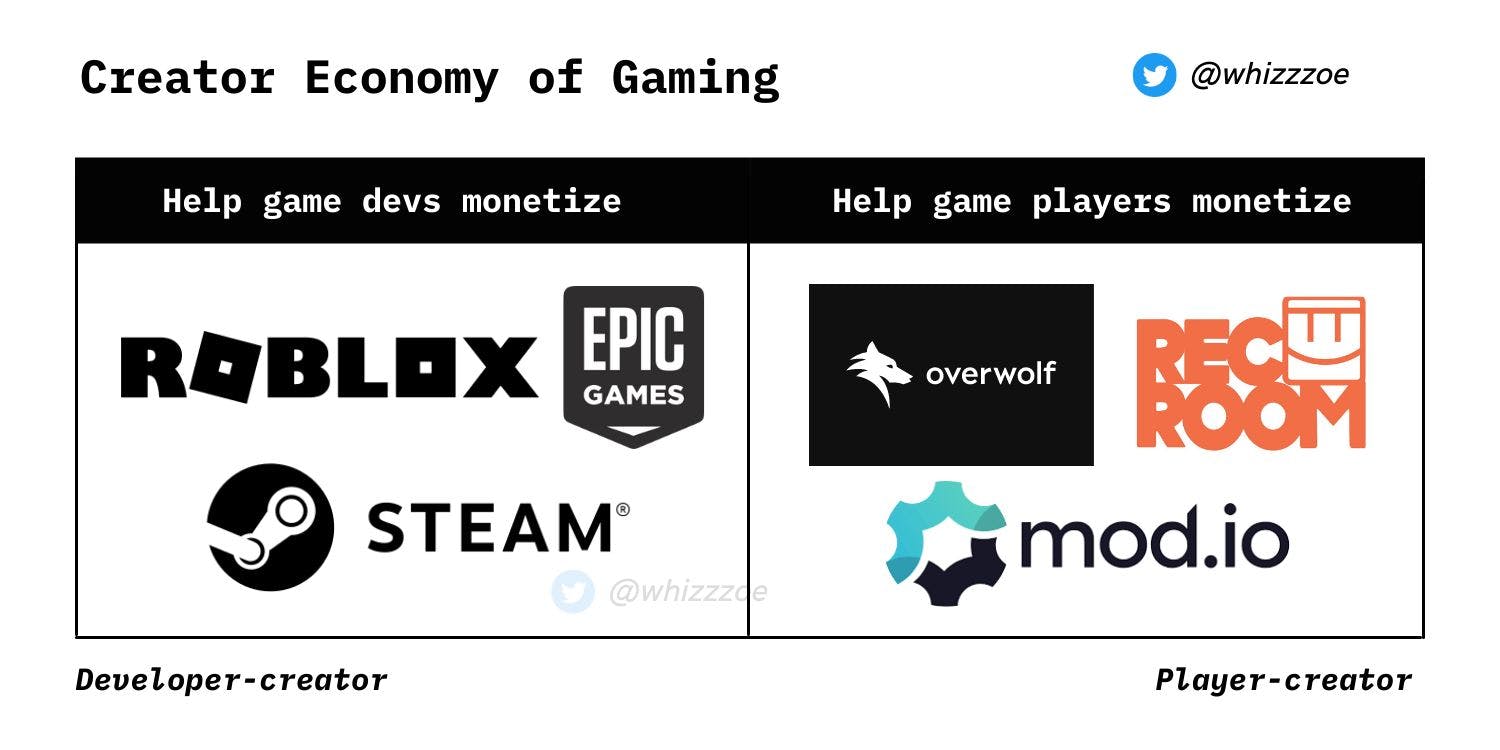
This article is part of my ↗️ where I share insights on building things in tech. Join me :) Note: resource newsletters 👋 I’m , a product builder. I’ve built multiple apps using the method: , , , , , , +more Zoe Chew rapid MVP sneaker app personal FAQ meal kit app virtual event app SaaS tracker food delivery content app I’m on a quest to understand the . Each week at , I analyze profitable industries, and how you can compete and monetize—at the intersection of Internet platforms & consumer tech. future of the Internet Venturescale Today’s post is about gaming tech. Read here if you’re interested in , , , or , SaaS Web3 creators economy future of social networks FinTech & wellness tech online marketplaces . In this analysis, we will unlock 3 market opportunities: Help game creators make money, i.e. people who build and sell games Help game players (the player-creator) make money Monetize gaming tech and game businesses by solving real problems Video games and the creator economy From big game studios to independent game developers making money by releasing , the creator economy has arrived in the gaming space. Unlike video games released by major publishers with titles (e.g. , , , ), indie games are created by solo game developers or smaller game studios without large marketing budgets or funding. “indie games” AAA Grand Theft Auto Call of Duty Halo Final Fantasy In 2020, there were (up from 2019). , , , , and have gained mainstream popularity among casual gamers during the pandemic lockdown. Work-from-home has created opportunities for indie developers to work on side projects and release games. 9,722 indie games released 25.6% Hades Among Us Fall Guys Spiritfarer Paradise Killer Empower game makers to monetize New have enabled game developers to sell their new games and reach wider audiences: digital distribution channels has over of game publishers selling their games on the platform. Steam 47% offers a game creation ( ) plus publishing platform. Users can program games and play games created by other users. Roblox Roblox Studio helps developers their games, set up their game page, and collaborate with game influencers. Epic Games self-publish is a publisher focusing on the best classic games niche. GOG 7 more company examples and unique value propositions (📥 Full version) The rise of UGC and player-creators Now there are two types of game creators. (1) People who video games which we’ve already mentioned. (2) People who such as avatars, skins, gifts, collectibles, virtual worlds—or monetize storytelling through audience-building and streaming. They are known as the , game modders, or game content creators. code and sell play games and sell virtual goods in-game creators User-generated content (UGC) platforms allow game players to participate in the gaming creators’ economy and monetize virtual worlds. Key players include: is for creating, sharing, and monetizing in-game apps and mods. Overwolf helps players create , host, moderate, monetize, brand & grow a creator community. Mod.io game modding has over 2 million players who created in-game content such as player-made game rooms. The company raised $100 million to extend more than in payouts for creators. Rec Room $1 million 5 more game creators monetization tools (📥 Full version) What problems do they solve? Game publishers like Steam, Roblox, GOG provide a listing of popular video games, recommend new releases, and a marketplace for players to discover, download or play new games. They are the “app store” for game distribution. Help people discover new games. Steam has monthly active players in 2020 (up 95 million from 2019). Roblox has daily users. Epic Games has 100 million players on the platforms. Developers can leverage these publishing platforms to increase game revenues. Connect developers with players. 120 million 33.4 million 3 more valid problems existing players are solving. Understanding these valid problems will help you build something people want. You’ll also learn: (📥 Full version) How are Roblox & Epic Games solving problems for game developers? Problem definition 1: How Steam generates additional revenue by solving this problem? Problem definition 2: What problem does Mod.io solve to make money as a business? Problem definition 3: Business models In the past, the gaming industry monetizes through selling game copies. Newer business models known as game-as-a-service (GaaS) are thriving in the gaming space to help publishers, developers, and game creators monetize better: ($4.99/mo, access 200+ games) bundles unlimited access to a selection of games, focuses on mobile-first gaming and Apple devices. ($14.99/mo, access 100+ games) focuses on indie, blockbuster games, and cross-platform subscriptions on console, PC, and mobile devices Game subscription: Apple Arcade Xbox Game Pass Ultimate invested in Epic Games back in 2012 to expand its model—a more profitable business model than selling game copies (one-time model). Similar to Freemium in SaaS, players can play a fully functional game, and then pay “upgrade” fees for buying virtual goods, unlocking next levels, playing without ads, new game updates, or big releases. Free-to-play : Tencent $330 million free-to-play 2 more strategies to help you layer different revenue streams and build a profitable game tech business. You’ll also learn: (📥 Full version) How to use this model to reduce marketing costs or user acquisition efforts? Strategy 1: Most popular way (due to its flexibility) to expand your revenue streams as a game business, including examples of big game studios applying this model. Strategy 2: Why now? There are massive opportunities for building in the gaming space. This section explores the key takeaways, the future of gaming tech, and the “why now” questions (most important slide in a pitch deck!) for your investors: People find gamers friends online, join groups, play together and socialize. Natural network effects happen when players attract more players by inviting their friends. Lower marketing costs due to community-driven platforms. , new creators platforms will emerge to help passionate players create, sell & trade virtual goods and earn side incomes. Similarly in the adjacent player-creator category, game influencers will leverage storytelling or live-streaming to help game studios distribute new games. As the creator economy rises 5 more market evidence in detail to help you make smart entrepreneurial decisions. You’ll also learn: (📥 Full version) Why the rise of new gaming business models will drive demand for adjacent product categories to rise? Evidence 1: New problems have started to emerge in the creators’ economy and why new solutions are needed? Evidence 2: Competition in creators economy is rising and why new solutions are needed to drive out competition and win? Evidence 3: Impact of eSports and the next-gen game tech solutions Evidence 4: Why gaming tech should cater their solutions to this user behavior shift? Evidence 5: Business opportunities Think direct-to-consumers (D2C) but for gaming. Build a digital commerce solution for game creators to easily set up their online storefront, cloud streaming, analytics, payment, and customer relationships through their own site. Having their own brand will be able to control the user experiences and eliminate platform fees on marketplaces like Steam, Epic Games, and GOG. Shopify for game businesses. 3 more specific product ideas and business opportunities that are solving problems. You’ll unlock: (📥 Full version) Game-as-a-service (GaaS) idea Opportunity 1: Monetize by helping game founders succeed Opportunity 2: Monetize by helping game developers succeed Opportunity 3: Niche business idea for no-code game creation platform Opportunity 4: 👉 Get the full report : here [1] Find me on my Personal Site / Twitter / LinkedIn 🔥 [2] Get venture reports in your inbox — Click here to join my newsletter 💌