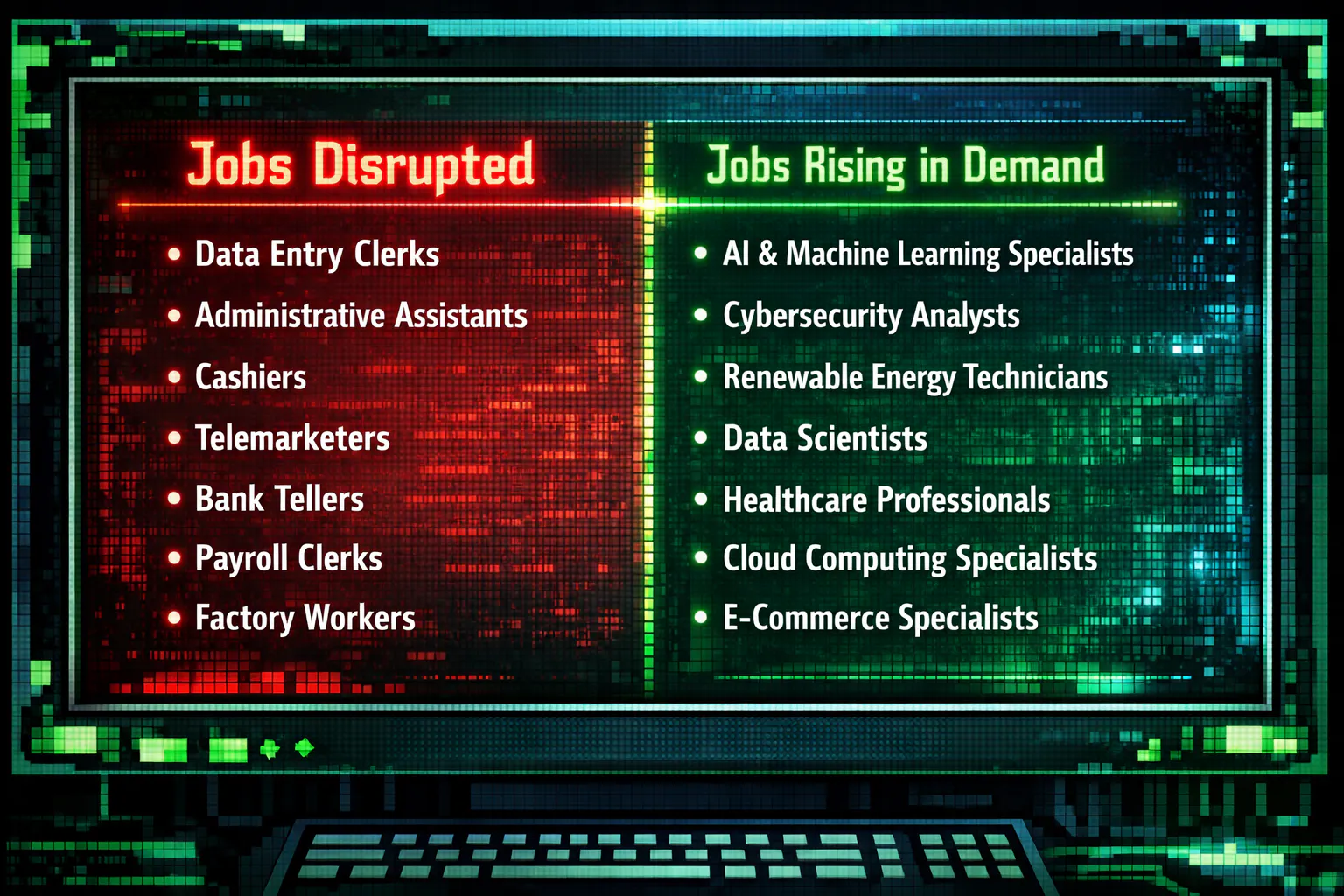
Analyzing the Empirical Implications of Generative Artificial Intelligence on the Labor Market Analyzing the Empirical Implications of Generative Artificial Intelligence on the Labor Market The rapid proliferation and enterprise-wide integration of Large Language Models (LLMs) and generative artificial intelligence represent a watershed moment in the macroeconomic landscape. As computational parameters scale and natural language processing reaches near-human sophistication across various cognitive tasks, the fundamental structure of global knowledge work is undergoing a profound and accelerating transformation. Public discourse surrounding this shift has often been polarized, characterized by viral social media prognostications asserting that entire swathes of the workforce—particularly those in data entry, telemarketing, and accounting—will soon cease to exist, while roles requiring physical touch, such as nursing and plumbing, remain untouched. To move beyond anecdotal speculation and quantify these exact labor market shifts, Microsoft Research published an exhaustive empirical study. Microsoft Research published an exhaustive empirical study Unlike previous academic forecasts that relied heavily on speculative economic modeling or theoretical task taxonomies, this Microsoft study anchors its findings in the empirical reality of enterprise and consumer behavior. The researchers analyzed a massive, privacy-scrubbed dataset comprising over 200,000 real-world interactions between human users and the Microsoft Bing Copilot system over a nine-month period in 2024. By mapping the intent, frequency, and success rates of these generative AI conversations against the expansive O*NET 29.0 database—which categorizes the specific Intermediate Work Activities (IWAs) of hundreds of professions—the research provides a highly granular, data-driven analysis of which occupations face the highest exposure to algorithmic automation, and which remain heavily insulated. massive, privacy-scrubbed dataset The trustworthiness and epistemological validity of this study are exceptionally high, stemming directly from its massive scale and its strict reliance on real-world usage telemetry rather than laboratory benchmarking. The research methodology was rigorously vetted and approved by the Microsoft Institutional Review Board (IRB), ensuring strict ethical compliance, robust anonymization protocols, and the protection of proprietary user data. The study's authors—Kiran Tomlinson, Sonia Jaffe, Will Wang, Scott Counts, and Siddharth Suri—bring deep, multidisciplinary expertise from Microsoft's AI Interaction and Learning group, the Economics and Computation division, and the AI Economy Institute. To quantitatively measure a profession's vulnerability to generative systems, the researchers developed an innovative "AI Applicability Score." This metric is uniquely multifaceted and is derived by calculating the product of three distinct variables across different Intermediate Work Activities: Coverage: The fraction of an occupation's tasks (weighted by importance and relevance) that users actively attempt to perform using AI.Completion: The fraction of these conversations where a classifying algorithm indicates the user’s specific goal was successfully completed by the AI.Scope: The fraction of conversations where the classified scope of impact on the overarching workflow is deemed "moderate" or higher. Coverage: The fraction of an occupation's tasks (weighted by importance and relevance) that users actively attempt to perform using AI. Coverage: Completion: The fraction of these conversations where a classifying algorithm indicates the user’s specific goal was successfully completed by the AI. Completion: Scope: The fraction of conversations where the classified scope of impact on the overarching workflow is deemed "moderate" or higher. Scope: The resulting applicability scores paint a stark picture of a bifurcating labor market. On one end of the spectrum, routine cognitive, linguistic, and administrative tasks face immense disruptive pressure and high applicability scores. On the opposite end, localized physical labor, manual dexterity, and human empathy remain heavily insulated, registering scores near absolute zero. However, a truly rigorous understanding of this data requires acknowledging the analytical gaps and inherent limitations of the study. The most critical caveat articulated by the Microsoft researchers is the necessity of avoiding the "Displacement Fallacy"—the assumption that high algorithmic applicability directly equates to inevitable, mass unemployment. The researchers explicitly cautioned against this assumption, noting that "It is tempting to conclude that occupations that have high overlap with activities AI performs will be automated and thus experience job or wage loss," but warning that the downstream business impacts of artificial intelligence are actually "very hard to predict and often counterintuitive". Generative AI currently operates primarily as a tool of workflow augmentation rather than a wholesale replacement mechanism. While it is highly capable of executing isolated tasks, the researchers stressed that "Our data do not indicate that AI is performing all of the work activities of any one occupation". "very hard to predict and often counterintuitive" A job is fundamentally more than a disconnected collection of discrete O*NET tasks; it involves nuanced interpersonal judgment, real-time domain-specific intuition, and ethical considerations that algorithms cannot replicate. Furthermore, the study's scope is strictly confined to interactions with text-based and multimodal conversational chatbots (Bing Copilot), completely omitting the potential labor impacts of predictive machine learning systems, physical robotics, and autonomous industrial machinery. Consequently, while the findings accurately highlight which professions will undergo the most severe workflow transformations, the ultimate macroeconomic outcome—whether characterized by catastrophic job displacement or an unprecedented surge in augmented human productivity—remains a highly complex and evolving phenomenon. The 40 Occupations Most Vulnerable to Generative Artificial Intelligence Disruption The 40 Occupations Most Vulnerable to Generative Artificial Intelligence Disruption The occupations identified as most vulnerable to generative AI share a fundamental characteristic: their core value propositions rely almost entirely on the cognitive processing, structuring, formatting, and communication of text, data, and routine logic. The roles with the highest AI applicability scores are overwhelmingly concentrated in the knowledge economy. Table 3 from the Microsoft study, reproduced below, details the top 40 occupations with the highest AI applicability scores, illuminating the profound scope and completion rates achieved by generative tools in these fields. The following analysis details the exact dynamics and mechanistic vulnerabilities for each of these forty highly disrupted professions, explaining the technological and economic drivers behind their respective AI applicability scores. Interpreters and Translators face the absolute highest exposure in the modern labor market, holding a staggering AI applicability score of 0.49 and a task coverage rate of 0.98. The report explicitly highlights this risk, noting that "Jobs such as translators, historians, writers, data scientists, and customer service representatives rank high on Microsoft's AI applicability score, a measure of how likely their work tasks are affected by AI". Because LLMs are fundamentally designed as semantic processing engines, the demand for routine, entry-level translation is expected to decline sharply, transitioning human workers primarily into localized editorial oversight roles.Historians confront a deeply structural disruption to their traditional methodologies; with a coverage score of 0.91, archival synthesis and document analysis are increasingly outsourced to algorithmic systems. As(https://www.reddit.com/r/SECourses/comments/1m82m0s/here_top_40_professions_that_will_be_replaced_by/) have pointed out, "A lot of historian work is highly skilled data entry, but to an AI Data entry is data entry," indicating that while high-level historical narrative crafting remains secure, the demand for base-level historical research assistants will inevitably decline as AI instantaneously parses centuries of digitized primary sources.Passenger Attendants register a surprisingly high applicability score of 0.47 and a completion rate of 0.88, driven by the automation of routine passenger inquiries and logistical coordination. Demand for human attendants is expected to decrease as transportation hubs increasingly deploy location-aware, generative digital kiosks and mobile AI interfaces that can preemptively and autonomously handle routine travel troubleshooting without requiring human intervention.Sales Representatives of Services face an impending transformation of their core daily workflows, with an AI completion rate of 0.90 indicating profound algorithmic success in this domain. The automation of initial client engagement, personalized email drafting, and CRM management means that while top-tier relationship builders will remain employed, the overall volume of required sales representatives will decline as one AI-augmented worker completes the output of several traditional employees.Writers and Authors are confronting an existential disruption to content generation, as modern algorithms rapidly master syntactic structuring, tonal mimicry, and thematic organization. The Microsoft report specifically isolated this vulnerability, observing that "Positions with the highest AI applicability scores included interpreters... writers and authors," confirming that demand for low-to-mid-tier commercial copywriting and generic content creation is already experiencing a severe and permanent market contraction.Customer Service Representatives are positioned at the epicenter of the automation revolution, with an AI completion rate of 0.90 signaling that conversational agents can flawlessly resolve the vast majority of consumer interactions. Economic forecasting surrounding this specific sector is notably grim, with McKinsey researchers predicting that "customer service roles are among the four categories that 'will, kind of, be going away,'" suggesting a massive, irreversible decline in global call center employment over the next decade.CNC Tool Programmers face heavy disruption because generative algorithms are uniquely proficient at translating geometric schematics into optimized computer-numerical-control machine code. With a task coverage rate of 0.90, the demand for human CNC programmers will likely decline as factories integrate AI systems that can autonomously generate, test, and refine manufacturing code in a fraction of the time required by human engineers.Telephone Operators are experiencing near-total market elimination; sophisticated natural language processing algorithms and interactive voice response tools can instantly parse complex phonetic inputs across multiple languages. Because an AI system can achieve a completion rate of 0.86 in these routing tasks, the necessity for human operators to direct calls or provide directory assistance has been effectively nullified, leading to a terminal decline in this profession.Ticket Agents and Travel Clerks are projected to experience a severe contraction in hiring as autonomous booking platforms effortlessly reference global databases to resolve multi-leg, complex logistical itineraries faster than any human agent. With an AI completion rate of 0.90 for their work activities, the demand for manual ticket clerking will plummet as consumers increasingly rely on multimodal, generative travel assistants embedded directly in their smartphones.Broadcast Announcers and Radio DJs will likely experience a sharp reduction in traditional opportunities, as AI-driven voice synthesis and algorithmic playlist curation can reliably mimic human cadence, emotion, and entertainment programming. The ability of generative tools to dynamically generate localized news, weather, and conversational banter implies a declining demand for human radio personalities in all but the highest-tier, personality-driven broadcast markets.Brokerage Clerks function under immense disruptive pressures, as their core responsibilities center on processing highly structured financial data. With an AI completion score of 0.89, demand for these roles will plummet as LLMs instantaneously reconcile complex ledger entries, verify regulatory compliance, and execute transaction protocols with zero margin for error, significantly outperforming human processing speeds.Farm and Home Management Educators face unexpected obsolescence as advanced models disseminate hyper-personalized, climate-specific agricultural advice and domestic optimization strategies directly to global users. The impressive 0.91 AI completion rate in this field suggests that traditional, human-led rural extension programs will decline in demand as farmers increasingly consult specialized agricultural LLMs for real-time crop management and soil analysis.Telemarketers represent one of the most vulnerable professions in the modern economy; industry analysis explicitly warns that "Telemarketers face the highest exposure–meaning about 96 out of every 100 tasks could potentially be automated". As AI voice agents become indistinguishable from humans and capable of navigating complex sales scripts dynamically, the demand for human telemarketing labor will effectively drop to zero.Concierges will see their employment demand wane as location-aware, generative AI assistants integrated into personal mobile devices provide immediate, highly accurate, and hyper-personalized hospitality recommendations. Because an AI can reference real-time global databases for dining, entertainment, and logistics with a completion rate of 0.88, the traditional hotel concierge desk will largely be replaced by digital hotel interfaces.Political Scientists are deeply exposed due to the research-heavy, linguistic nature of their daily work; the findings stipulate that "Positions with the highest AI applicability scores included interpreters, journalists, political scientists... [which] heavily involve research, communication, and writing". While high-level political strategy remains secure, the demand for junior political analysts will decline as AI instantaneously aggregates and summarizes vast quantities of polling data, legislative text, and historical trends.News Analysts, Reporters, Journalists face a rapidly declining market demand for routine reporting, financial journalism, and sports recaps. The data reveals that "Positions with the highest AI applicability scores included... journalists... [where] AI demonstrates strong performance," indicating that newsrooms will increasingly rely on algorithmic generation for standard news copy, reserving human journalists exclusively for deeply embedded investigative reporting.Mathematicians are witnessing structural changes to their workflows, primarily because generative AI can instantly assist in formulating proofs, checking complex calculations, and modeling theoretical frameworks. The study confirms that "Positions with the highest AI applicability scores included interpreters, journalists, political scientists, web developers, mathematicians," suggesting that while top-tier theoretical work will persist, routine mathematical modeling demand will decline.Technical Writers face a contracting labor market because generative systems excel at instantly synthesizing dense engineering specifications, API documentation, and software code into readable, localized manuals. With a task coverage of 0.83, the human translation bottleneck between software engineers and end-users is eliminated, allowing tech companies to drastically reduce their technical writing headcounts.Proofreaders and Copy Markers are highly vulnerable because their primary function relies on automatable, rule-based logic and syntax detection. The research indicates that "Jobs such as translators, historians, writers... rank high on Microsoft's AI applicability score", an analytical paradigm that logically guarantees a severe decline in demand for copy markers as AI achieves superhuman accuracy in grammar, pacing, and structural error detection.Hosts and Hostesses face a declining labor market as advanced restaurant scheduling interfaces and predictive algorithms autonomously manage guest flow, waitlists, and table optimization with a mathematical precision that humans cannot match. Achieving an AI completion rate of 0.90, digital hosting systems will increasingly replace the physical presence of hosts at the front of dining and entertainment establishments.Editors are expected to see their traditional roles vastly diminished; advanced natural language processing has matured to a point where overarching structural edits, tonal adjustments, and pacing corrections can be executed instantaneously. With an AI completion rate of 0.82, publishing houses and media organizations will likely reduce editorial staff, relying on AI to perform the first and second passes of manuscript refinement.Business Teachers, Postsecondary face a contracting market as AI-driven personalized tutoring systems, democratized digital business simulations, and on-demand LLM case-study analyses replace foundational university lectures. As higher education paradigms shift toward asynchronous digital learning, the demand for human instructors teaching standardized business administration concepts will inevitably decline.Public Relations Specialists are highly exposed to generative content creation; the ability of AI to instantly draft press releases, monitor global brand sentiment, and generate crisis management communications limits the need for massive PR teams. With an AI completion rate of 0.90, agencies will augment their workflows, requiring fewer junior specialists to execute the vast amounts of communication necessary for modern corporate relations.Demonstrators and Product Promoters will see their roles increasingly substituted by digital innovation; demand will wane as virtual reality integrations, augmented reality overlays, and highly realistic AI-generated avatars deliver personalized, localized product demonstrations directly to global consumers at an infinite scale, circumventing the need for physical retail promoters.Advertising Sales Agents are actively competing against programmatic advertising algorithms that can autonomously negotiate, purchase, and optimize ad placements across the internet without human brokerage. Achieving an AI completion score of 0.90, the ad-tech industry's reliance on human sales agents will continue to decline as platforms transition to fully automated, self-serve generative ad generation and placement.New Accounts Clerks face intense, immediate disruption; expert industry analysis explicitly warns that "Accounts clerks have the most vulnerable jobs because their job involves the maximum repetition, such as invoice processing and payment scheduling". As a result, financial institutions will drastically reduce hiring for these roles, transitioning entirely to automated KYC (Know Your Customer) and account generation protocols.Statistical Assistants will face a rapidly shrinking labor market due to the integration of generative algorithms into mathematical modeling. Because artificial intelligence can instantly scrape, clean, format, and synthesize vast datasets with an 0.85 coverage rate, the necessity for human support staff in statistical departments is essentially nullified, shifting demand entirely toward high-level data interpretation.Counter and Rental Clerks are projected to experience a severe contraction in hiring as intelligent digital kiosks, equipped with conversational generative interfaces, seamlessly execute rental logistics, identity verification, and inventory management. With a completion rate of 0.90, car rental agencies, equipment suppliers, and retail counters will largely phase out human clerks in favor of automated, 24/7 digital service terminals.Data Scientists are experiencing profound workflow shifts, with the study confirming that "Jobs such as translators, historians, writers, data scientists, and customer service representatives rank high on Microsoft's AI applicability score". While high-level strategic data architecture will remain in demand, the routine coding, data cleaning, and basic exploratory data analysis that once required a massive workforce of junior data scientists will be heavily automated.Personal Financial Advisors face steep competition from highly personalized generative algorithms capable of dynamically optimizing portfolios based on real-time global market data and individual risk tolerance. Consequently, the research notes that "Positions with the highest AI applicability scores included... sales representatives, and personal finance advisors," indicating a shift toward AI-managed wealth platforms and a decline in demand for traditional human advisors.Archivists will likely experience massive displacement as generative systems capable of advanced metadata tagging, optical character recognition, and unstructured document retrieval permanently outpace human capacities for physical and digital cataloging. With an AI completion rate of 0.88, the tedious work of classifying historical and corporate documents will be fully automated, drastically reducing the demand for human archivists.Economics Teachers, Postsecondary will experience a decline in demand as generative economic modeling platforms provide interactive, instantly updated macroeconomic instruction to students globally. As educational platforms leverage AI to create dynamic, real-time economic simulations that adjust to a student's learning pace, the traditional university model relying on human lecturers will face significant labor contractions.Web Developers confront existential shifts in their daily labor, as LLMs become increasingly proficient at writing, debugging, and deploying boilerplate code and front-end architectures. The research explicitly highlighted that "Positions with the highest AI applicability scores included interpreters, journalists, political scientists, web developers," meaning that while senior software architects will thrive, demand for entry-level web development will plummet.Management Analysts will see their traditional consulting utility heavily diminished; generative systems can now ingest millions of internal corporate metrics, instantly outputting operational efficiency reports and strategic restructuring plans that previously required weeks of human labor. Achieving an AI completion score of 0.90, corporate reliance on massive external teams of junior management analysts will steadily decline.Geographers face a declining labor market as geospatial artificial intelligence and satellite-linked LLMs continuously analyze topographic, demographic, and climate data streams, executing structural mapping tasks with unprecedented speed. With a task coverage of 0.77, the necessity for human geographers to manually interpret geographic information systems (GIS) data will be largely superseded by autonomous spatial computing.Models face a severe and highly visible decline in demand as fashion, e-commerce, and advertising agencies pivot toward highly realistic, AI-generated human avatars. Because digital models offer infinite, cost-free customization for digital campaigns without the logistical expenses of photoshoots, human commercial modeling will experience a massive contraction, leaving only top-tier supermodels insulated.Market Research Analysts are confronting a paradigm where AI platforms autonomously aggregate global consumer sentiment, conduct behavioral scraping, and analyze socio-economic trends in real-time. With an AI completion rate of 0.90, the demand for human compilation and basic analysis will drastically shrink, as marketing firms rely on algorithms to generate instantaneous, highly accurate consumer demographic profiles.Public Safety Telecommunicators face algorithmic encroachment; while human empathy remains critical in crises, the initial triage of emergency call data, linguistic translation, and optimal dispatch routing is increasingly being governed by rapid AI analytical processing. As AI achieves an 0.88 completion rate in these tasks, call centers will require fewer human operators, relying on them solely for complex emotional de-escalation while algorithms handle logistics.Switchboard Operators are fundamentally superseded by intelligent, voice-activated corporate telephony networks capable of flawless natural language understanding. This technological mechanism guarantees the terminal decline of this profession, as digital switchboards handle massive call volumes simultaneously, completely eradicating the need for human physical and digital call routing.Library Science Teachers, Postsecondary face a grim labor outlook, as the complete digitization of library science curricula and the autonomous operation of semantic research databases reduce the need for human instructors in this highly specialized niche. With an AI completion rate of 0.90, the academic demand for teaching physical cataloging and search methodologies will rapidly evaporate in the face of intuitive, AI-powered digital libraries. Interpreters and Translators face the absolute highest exposure in the modern labor market, holding a staggering AI applicability score of 0.49 and a task coverage rate of 0.98. The report explicitly highlights this risk, noting that "Jobs such as translators, historians, writers, data scientists, and customer service representatives rank high on Microsoft's AI applicability score, a measure of how likely their work tasks are affected by AI". Because LLMs are fundamentally designed as semantic processing engines, the demand for routine, entry-level translation is expected to decline sharply, transitioning human workers primarily into localized editorial oversight roles. Interpreters and Translators "Jobs such as translators, historians, writers, data scientists, and customer service representatives rank high on Microsoft's AI applicability score, a measure of how likely their work tasks are affected by AI" Historians confront a deeply structural disruption to their traditional methodologies; with a coverage score of 0.91, archival synthesis and document analysis are increasingly outsourced to algorithmic systems. As(https://www.reddit.com/r/SECourses/comments/1m82m0s/here_top_40_professions_that_will_be_replaced_by/) have pointed out, "A lot of historian work is highly skilled data entry, but to an AI Data entry is data entry," indicating that while high-level historical narrative crafting remains secure, the demand for base-level historical research assistants will inevitably decline as AI instantaneously parses centuries of digitized primary sources. Historians https://www.reddit.com/r/SECourses/comments/1m82m0s/here_top_40_professions_that_will_be_replaced_by/) Passenger Attendants register a surprisingly high applicability score of 0.47 and a completion rate of 0.88, driven by the automation of routine passenger inquiries and logistical coordination. Demand for human attendants is expected to decrease as transportation hubs increasingly deploy location-aware, generative digital kiosks and mobile AI interfaces that can preemptively and autonomously handle routine travel troubleshooting without requiring human intervention. Passenger Attendants Sales Representatives of Services face an impending transformation of their core daily workflows, with an AI completion rate of 0.90 indicating profound algorithmic success in this domain. The automation of initial client engagement, personalized email drafting, and CRM management means that while top-tier relationship builders will remain employed, the overall volume of required sales representatives will decline as one AI-augmented worker completes the output of several traditional employees. Sales Representatives of Services Writers and Authors are confronting an existential disruption to content generation, as modern algorithms rapidly master syntactic structuring, tonal mimicry, and thematic organization. The Microsoft report specifically isolated this vulnerability, observing that "Positions with the highest AI applicability scores included interpreters... writers and authors," confirming that demand for low-to-mid-tier commercial copywriting and generic content creation is already experiencing a severe and permanent market contraction. Writers and Authors "Positions with the highest AI applicability scores included interpreters... writers and authors," Customer Service Representatives are positioned at the epicenter of the automation revolution, with an AI completion rate of 0.90 signaling that conversational agents can flawlessly resolve the vast majority of consumer interactions. Economic forecasting surrounding this specific sector is notably grim, with McKinsey researchers predicting that "customer service roles are among the four categories that 'will, kind of, be going away,'" suggesting a massive, irreversible decline in global call center employment over the next decade. Customer Service Representatives "customer service roles are among the four categories that 'will, kind of, be going away,'" CNC Tool Programmers face heavy disruption because generative algorithms are uniquely proficient at translating geometric schematics into optimized computer-numerical-control machine code. With a task coverage rate of 0.90, the demand for human CNC programmers will likely decline as factories integrate AI systems that can autonomously generate, test, and refine manufacturing code in a fraction of the time required by human engineers. CNC Tool Programmers Telephone Operators are experiencing near-total market elimination; sophisticated natural language processing algorithms and interactive voice response tools can instantly parse complex phonetic inputs across multiple languages. Because an AI system can achieve a completion rate of 0.86 in these routing tasks, the necessity for human operators to direct calls or provide directory assistance has been effectively nullified, leading to a terminal decline in this profession. Telephone Operators Ticket Agents and Travel Clerks are projected to experience a severe contraction in hiring as autonomous booking platforms effortlessly reference global databases to resolve multi-leg, complex logistical itineraries faster than any human agent. With an AI completion rate of 0.90 for their work activities, the demand for manual ticket clerking will plummet as consumers increasingly rely on multimodal, generative travel assistants embedded directly in their smartphones. Ticket Agents and Travel Clerks Broadcast Announcers and Radio DJs will likely experience a sharp reduction in traditional opportunities, as AI-driven voice synthesis and algorithmic playlist curation can reliably mimic human cadence, emotion, and entertainment programming. The ability of generative tools to dynamically generate localized news, weather, and conversational banter implies a declining demand for human radio personalities in all but the highest-tier, personality-driven broadcast markets. Broadcast Announcers and Radio DJs Brokerage Clerks function under immense disruptive pressures, as their core responsibilities center on processing highly structured financial data. With an AI completion score of 0.89, demand for these roles will plummet as LLMs instantaneously reconcile complex ledger entries, verify regulatory compliance, and execute transaction protocols with zero margin for error, significantly outperforming human processing speeds. Brokerage Clerks Farm and Home Management Educators face unexpected obsolescence as advanced models disseminate hyper-personalized, climate-specific agricultural advice and domestic optimization strategies directly to global users. The impressive 0.91 AI completion rate in this field suggests that traditional, human-led rural extension programs will decline in demand as farmers increasingly consult specialized agricultural LLMs for real-time crop management and soil analysis. Farm and Home Management Educators Telemarketers represent one of the most vulnerable professions in the modern economy; industry analysis explicitly warns that "Telemarketers face the highest exposure–meaning about 96 out of every 100 tasks could potentially be automated". As AI voice agents become indistinguishable from humans and capable of navigating complex sales scripts dynamically, the demand for human telemarketing labor will effectively drop to zero. Telemarketers industry analysis explicitly warns Concierges will see their employment demand wane as location-aware, generative AI assistants integrated into personal mobile devices provide immediate, highly accurate, and hyper-personalized hospitality recommendations. Because an AI can reference real-time global databases for dining, entertainment, and logistics with a completion rate of 0.88, the traditional hotel concierge desk will largely be replaced by digital hotel interfaces. Concierges Political Scientists are deeply exposed due to the research-heavy, linguistic nature of their daily work; the findings stipulate that "Positions with the highest AI applicability scores included interpreters, journalists, political scientists... [which] heavily involve research, communication, and writing". While high-level political strategy remains secure, the demand for junior political analysts will decline as AI instantaneously aggregates and summarizes vast quantities of polling data, legislative text, and historical trends. Political Scientists "Positions with the highest AI applicability scores included interpreters, journalists, political scientists... [which] heavily involve research, communication, and writing" News Analysts, Reporters, Journalists face a rapidly declining market demand for routine reporting, financial journalism, and sports recaps. The data reveals that "Positions with the highest AI applicability scores included... journalists... [where] AI demonstrates strong performance," indicating that newsrooms will increasingly rely on algorithmic generation for standard news copy, reserving human journalists exclusively for deeply embedded investigative reporting. News Analysts, Reporters, Journalists "Positions with the highest AI applicability scores included... journalists... [where] AI demonstrates strong performance," Mathematicians are witnessing structural changes to their workflows, primarily because generative AI can instantly assist in formulating proofs, checking complex calculations, and modeling theoretical frameworks. The study confirms that "Positions with the highest AI applicability scores included interpreters, journalists, political scientists, web developers, mathematicians," suggesting that while top-tier theoretical work will persist, routine mathematical modeling demand will decline. Mathematicians "Positions with the highest AI applicability scores included interpreters, journalists, political scientists, web developers, mathematicians," Technical Writers face a contracting labor market because generative systems excel at instantly synthesizing dense engineering specifications, API documentation, and software code into readable, localized manuals. With a task coverage of 0.83, the human translation bottleneck between software engineers and end-users is eliminated, allowing tech companies to drastically reduce their technical writing headcounts. Technical Writers Proofreaders and Copy Markers are highly vulnerable because their primary function relies on automatable, rule-based logic and syntax detection. The research indicates that "Jobs such as translators, historians, writers... rank high on Microsoft's AI applicability score", an analytical paradigm that logically guarantees a severe decline in demand for copy markers as AI achieves superhuman accuracy in grammar, pacing, and structural error detection. Proofreaders and Copy Markers "Jobs such as translators, historians, writers... rank high on Microsoft's AI applicability score" Hosts and Hostesses face a declining labor market as advanced restaurant scheduling interfaces and predictive algorithms autonomously manage guest flow, waitlists, and table optimization with a mathematical precision that humans cannot match. Achieving an AI completion rate of 0.90, digital hosting systems will increasingly replace the physical presence of hosts at the front of dining and entertainment establishments. Hosts and Hostesses Editors are expected to see their traditional roles vastly diminished; advanced natural language processing has matured to a point where overarching structural edits, tonal adjustments, and pacing corrections can be executed instantaneously. With an AI completion rate of 0.82, publishing houses and media organizations will likely reduce editorial staff, relying on AI to perform the first and second passes of manuscript refinement. Editors Business Teachers, Postsecondary face a contracting market as AI-driven personalized tutoring systems, democratized digital business simulations, and on-demand LLM case-study analyses replace foundational university lectures. As higher education paradigms shift toward asynchronous digital learning, the demand for human instructors teaching standardized business administration concepts will inevitably decline. Business Teachers, Postsecondary Public Relations Specialists are highly exposed to generative content creation; the ability of AI to instantly draft press releases, monitor global brand sentiment, and generate crisis management communications limits the need for massive PR teams. With an AI completion rate of 0.90, agencies will augment their workflows, requiring fewer junior specialists to execute the vast amounts of communication necessary for modern corporate relations. Public Relations Specialists Demonstrators and Product Promoters will see their roles increasingly substituted by digital innovation; demand will wane as virtual reality integrations, augmented reality overlays, and highly realistic AI-generated avatars deliver personalized, localized product demonstrations directly to global consumers at an infinite scale, circumventing the need for physical retail promoters. Demonstrators and Product Promoters Advertising Sales Agents are actively competing against programmatic advertising algorithms that can autonomously negotiate, purchase, and optimize ad placements across the internet without human brokerage. Achieving an AI completion score of 0.90, the ad-tech industry's reliance on human sales agents will continue to decline as platforms transition to fully automated, self-serve generative ad generation and placement. Advertising Sales Agents New Accounts Clerks face intense, immediate disruption; expert industry analysis explicitly warns that "Accounts clerks have the most vulnerable jobs because their job involves the maximum repetition, such as invoice processing and payment scheduling". As a result, financial institutions will drastically reduce hiring for these roles, transitioning entirely to automated KYC (Know Your Customer) and account generation protocols. New Accounts Clerks expert industry analysis explicitly warns Statistical Assistants will face a rapidly shrinking labor market due to the integration of generative algorithms into mathematical modeling. Because artificial intelligence can instantly scrape, clean, format, and synthesize vast datasets with an 0.85 coverage rate, the necessity for human support staff in statistical departments is essentially nullified, shifting demand entirely toward high-level data interpretation. Statistical Assistants Counter and Rental Clerks are projected to experience a severe contraction in hiring as intelligent digital kiosks, equipped with conversational generative interfaces, seamlessly execute rental logistics, identity verification, and inventory management. With a completion rate of 0.90, car rental agencies, equipment suppliers, and retail counters will largely phase out human clerks in favor of automated, 24/7 digital service terminals. Counter and Rental Clerks Data Scientists are experiencing profound workflow shifts, with the study confirming that "Jobs such as translators, historians, writers, data scientists, and customer service representatives rank high on Microsoft's AI applicability score". While high-level strategic data architecture will remain in demand, the routine coding, data cleaning, and basic exploratory data analysis that once required a massive workforce of junior data scientists will be heavily automated. Data Scientists "Jobs such as translators, historians, writers, data scientists, and customer service representatives rank high on Microsoft's AI applicability score" Personal Financial Advisors face steep competition from highly personalized generative algorithms capable of dynamically optimizing portfolios based on real-time global market data and individual risk tolerance. Consequently, the research notes that "Positions with the highest AI applicability scores included... sales representatives, and personal finance advisors," indicating a shift toward AI-managed wealth platforms and a decline in demand for traditional human advisors. Personal Financial Advisors "Positions with the highest AI applicability scores included... sales representatives, and personal finance advisors," Archivists will likely experience massive displacement as generative systems capable of advanced metadata tagging, optical character recognition, and unstructured document retrieval permanently outpace human capacities for physical and digital cataloging. With an AI completion rate of 0.88, the tedious work of classifying historical and corporate documents will be fully automated, drastically reducing the demand for human archivists. Archivists Economics Teachers, Postsecondary will experience a decline in demand as generative economic modeling platforms provide interactive, instantly updated macroeconomic instruction to students globally. As educational platforms leverage AI to create dynamic, real-time economic simulations that adjust to a student's learning pace, the traditional university model relying on human lecturers will face significant labor contractions. Economics Teachers, Postsecondary Web Developers confront existential shifts in their daily labor, as LLMs become increasingly proficient at writing, debugging, and deploying boilerplate code and front-end architectures. The research explicitly highlighted that "Positions with the highest AI applicability scores included interpreters, journalists, political scientists, web developers," meaning that while senior software architects will thrive, demand for entry-level web development will plummet. Web Developers "Positions with the highest AI applicability scores included interpreters, journalists, political scientists, web developers," Management Analysts will see their traditional consulting utility heavily diminished; generative systems can now ingest millions of internal corporate metrics, instantly outputting operational efficiency reports and strategic restructuring plans that previously required weeks of human labor. Achieving an AI completion score of 0.90, corporate reliance on massive external teams of junior management analysts will steadily decline. Management Analysts Geographers face a declining labor market as geospatial artificial intelligence and satellite-linked LLMs continuously analyze topographic, demographic, and climate data streams, executing structural mapping tasks with unprecedented speed. With a task coverage of 0.77, the necessity for human geographers to manually interpret geographic information systems (GIS) data will be largely superseded by autonomous spatial computing. Geographers Models face a severe and highly visible decline in demand as fashion, e-commerce, and advertising agencies pivot toward highly realistic, AI-generated human avatars. Because digital models offer infinite, cost-free customization for digital campaigns without the logistical expenses of photoshoots, human commercial modeling will experience a massive contraction, leaving only top-tier supermodels insulated. Models Market Research Analysts are confronting a paradigm where AI platforms autonomously aggregate global consumer sentiment, conduct behavioral scraping, and analyze socio-economic trends in real-time. With an AI completion rate of 0.90, the demand for human compilation and basic analysis will drastically shrink, as marketing firms rely on algorithms to generate instantaneous, highly accurate consumer demographic profiles. Market Research Analysts Public Safety Telecommunicators face algorithmic encroachment; while human empathy remains critical in crises, the initial triage of emergency call data, linguistic translation, and optimal dispatch routing is increasingly being governed by rapid AI analytical processing. As AI achieves an 0.88 completion rate in these tasks, call centers will require fewer human operators, relying on them solely for complex emotional de-escalation while algorithms handle logistics. Public Safety Telecommunicators Switchboard Operators are fundamentally superseded by intelligent, voice-activated corporate telephony networks capable of flawless natural language understanding. This technological mechanism guarantees the terminal decline of this profession, as digital switchboards handle massive call volumes simultaneously, completely eradicating the need for human physical and digital call routing. Switchboard Operators Library Science Teachers, Postsecondary face a grim labor outlook, as the complete digitization of library science curricula and the autonomous operation of semantic research databases reduce the need for human instructors in this highly specialized niche. With an AI completion rate of 0.90, the academic demand for teaching physical cataloging and search methodologies will rapidly evaporate in the face of intuitive, AI-powered digital libraries. Library Science Teachers, Postsecondary The 40 Occupations Most Secured Against Generative Artificial Intelligence Disruption The 40 Occupations Most Secured Against Generative Artificial Intelligence Disruption While the knowledge economy faces unprecedented algorithmic displacement, the Microsoft study explicitly identified a vast array of professions that remain fundamentally impervious to the current generation of artificial intelligence. These secured occupations possess an AI applicability score nearing absolute zero, a phenomenon rooted in Moravec's paradox—the observation that high-level reasoning requires very little computation, but low-level sensorimotor skills require enormous computational resources. These 40 jobs are united by their strict reliance on heavy manual labor, complex physical dexterity, unpredictable environmental navigation, and tactile human empathy. The researchers concluded that roles remaining secure "require manual labor, real-time decision-making, or physical presence, which current AI systems cannot replicate". Table 4 from the Microsoft study highlights the profound lack of algorithmic coverage in these critical physical sectors. "require manual labor, real-time decision-making, or physical presence, which current AI systems cannot replicate" The following details the structural reasons why these 40 professions will experience sustained or growing demand, heavily insulated against the generative AI revolution. Phlebotomists represent a highly secure profession due to the intense physical precision and psychological comfort required in their daily tasks. With an AI applicability score of just 0.03 and coverage of 0.06, demand for these clinical professionals will continue to grow, as extracting biological samples requires a level of tactile feedback and human empathy that software algorithms fundamentally cannot replicate.Nursing Assistants are similarly shielded from technological replacement by the core nature of hands-on patient care; the research specifically groups them among the safest professions, noting that "Nursing assistants, ship engineers, oral surgeons, massage therapists, maids, and roofers appear least vulnerable to AI disruption". As the global population ages, demand for the physical lifting, bathing, and empathetic monitoring provided by nursing assistants will skyrocket.Hazardous Materials Removal Workers are tasked with extracting toxic substances, asbestos, and biohazards, resulting in an AI coverage score of only 0.04. This profession requires specialized physical protective gear, complex spatial caution, and real-time environmental judgment in degrading structures, ensuring robust long-term demand for localized human labor that robotics cannot safely navigate.Helpers-Painters, Plasterers, and Related Workers engage in dynamic, localized manual labor across highly variable residential and commercial sites. Because they assist in physical applications that require navigating scaffolding and unstructured indoor environments, demand for these human helpers will remain highly stable, as algorithmic intelligence lacks the physical actuators to participate in site preparation.Embalmers perform highly sensitive, tactile, and physical mortuary care, reflecting an extraordinarily low AI completion rate of 0.55 for any overlapping tasks. The profound biological reality, legal sensitivity, and manual delicacy of preparing human remains ensures that embalming will remain a strictly human-operated profession with steady market demand.Plant and System Operators, All Other are necessary to oversee heavy industrial infrastructure; they execute localized manual overrides, physical valve adjustments, and safety patrols. With an AI coverage score of 0.05, the necessity to physically walk factory floors and react to real-time mechanical sensory input (smell, sound, vibration) guarantees that human operators will not be displaced by cloud-based AI.Oral and Maxillofacial Surgeons perform highly invasive physical surgeries on the complex human facial and skeletal structure. The Microsoft report accurately positions them in the safest tier, confirming that "Nursing assistants, ship engineers, oral surgeons... appear least vulnerable to AI disruption", as their elite manual skills and real-time biological adaptation permanently guarantee their unshakeable job security and high market value.Automotive Glass Installers and Repairers remain secure because the physical extraction, handling, and delicate fitting of heavy vehicular glass require intense spatial dexterity. AI software cannot physically manipulate shattered glass or apply customized adhesives in variable weather conditions, ensuring that demand for these highly specialized automotive technicians will continue to grow.Ship Engineers perform hands-on mechanical maintenance of highly complex, massive marine engines in isolated, deep-water environments. The report explicitly highlights them among the safest jobs, stating "Nursing assistants, ship engineers... appear least vulnerable to AI disruption," as maritime engineering mandates a physical, highly skilled human presence capable of executing emergency physical repairs without internet connectivity.Tire Repairers and Changers utilize raw manual force and tactile precision to extract, patch, and balance heavy automotive tires, keeping this localized profession completely insulated from digital displacement. With an AI applicability score of 0.02, demand for these physical laborers will remain constant, as no generative AI tool can physically lift a vehicle or torque a lug nut.Prosthodontists are fundamentally secure because Prosthodontists (dental specialists focused on the restoration and replacement of teeth) must combine high-level medical expertise with intricate physical dexterity inside the constrained environment of the human mouth. The demand for these specialists will grow alongside aging demographics, completely unimpeded by linguistic AI models.Helpers-Production Workers provide localized, physical support and material transport across chaotic factory floors. With an AI coverage score of just 0.04, human assistance remains a highly stable element of large-scale manufacturing operations, as providing dynamic physical support to heavy machine operators requires a level of general-purpose mobility that robots have yet to achieve economically.Highway Maintenance Workers will continue to see steady labor demand, as infrastructure repair inherently involves heavy manual labor amidst chaotic, highly unpredictable civilian traffic patterns. Operating heavy machinery to repair asphalt in real-time weather conditions yields an AI applicability score of 0.02, cementing the long-term job security of these civic laborers.Medical Equipment Preparers manage the precise physical sterilization, calibration, and assembly of delicate clinical tools. This process demands stringent manual oversight, tactile verification of cleanliness, and physical sorting, assuring the profession's ongoing security and growing demand within modern, high-volume hospital networks.Packaging and Filling Machine Operators must maintain the physical flow of consumer goods on fast-paced manufacturing lines. They provide the tactile troubleshooting, material reloading, and mechanical clearing of jams that software alone cannot physically resolve, meaning human oversight will remain a permanent fixture in logistics and packaging.Machine Feeders and Offbearers are required for the physical loading, untangling, and unloading of raw industrial materials, demanding a manual presence that secures these roles against purely cognitive automation. As long as physical goods are manufactured, the demand for human offbearers to perform rapid, variable physical sorting will remain strong.Dishwashers perform a heavily physical role characterized by highly variable object manipulation in wet, unstructured environments. Experts point out that(https://cloudtweaks.com/2025/07/40-jobs-most-vulnerable-ai-disruption/) making dishwashing entirely impervious to cost-effective robotic or AI substitution and guaranteeing ongoing demand in the hospitality sector.Cement Masons and Concrete Finishers must physically pour, manipulate, and smooth heavy construction materials before they cure. With an AI applicability score of 0.01, this role requires precise, real-time tactile feedback and weather-dependent physical adjustments that ensure the ongoing, unthreatened necessity of human masons in the construction industry.Supervisors of Firefighters lead response teams in highly hazardous, rapidly degrading physical environments; this demands unparalleled physical bravery, spatial command, and intuitive human leadership. Earning an AI score of 0.01, this high-stakes public safety role is completely secure from artificial intelligence, as software cannot physically rescue citizens or command a localized fireground.Industrial Truck and Tractor Operators must constantly navigate unstructured, chaotic industrial sites with heavy kinetic equipment. This requires a level of localized visual judgment, physical reflex, and spatial awareness that current AI algorithms cannot safely execute in isolation, ensuring strong continued demand for human heavy machinery operators.Ophthalmic Medical Technicians are required to operate delicate clinical machinery directly on the sensitive eyes of human patients. With an AI applicability score of 0.01, this localized physical presence requires gentle dexterity and human empathy to keep patients calm, functions that an AI software interface cannot safely or legally provide.Massage Therapists operate within a profession defined exclusively by kinesthetic feedback and human-to-human physical touch. The Microsoft study confirms their absolute occupational security, noting "massage therapists... appear least vulnerable to AI disruption," guaranteeing their enduring market demand in the wellness sector against any digital software alternative.Surgical Assistants are irreplaceable in the operating theater; "Surgical Assistants" require an elite combination of physical dexterity, real-time medical adaptation, and spatial coordination to safely manipulate surgical tools and retractors during unpredictable biological emergencies, securing their vital role in modern medicine.Tire Builders rely heavily on the physical manipulation of heavy rubber materials and complex vulcanization equipment in customized manufacturing environments. With an AI applicability score of just 0.01, the intense physical stamina and manual adjustments required in custom tire manufacturing secure the long-term viability of this hands-on profession.Helpers-Roofers are equally secure as master roofers, as providing manual assistance, lifting heavy shingles, and safely navigating high-altitude, steep-pitch construction sites necessitates a human physical presence. Because AI lacks physical mobility, the demand for human roofing assistants will remain robust and uninterrupted.Gas Compressor and Gas Pumping Station Operators provide the manual oversight of highly volatile pneumatic and chemical systems, ensuring that physical human operators remain strictly necessary. With an AI applicability score of 0.01, the need for humans to perform emergency physical valve overrides and localized sensory inspections guarantees their job security in the energy sector.Roofers engage in a trade requiring intense physical stamina, extraordinary balance, and spatial reasoning in constantly shifting, elevated outdoor environments. The data emphatically supports their security, stating that "massage therapists, maids, and roofers appear least vulnerable to AI disruption," guaranteeing robust and uninterrupted market demand for this hazardous physical labor.Roustabouts, Oil and Gas are deeply insulated from algorithmic replacement; labor market analysts confirm that "Roustabouts, Oil and Gas (workers who perform general labor on drilling rigs)" will experience sustained demand due to the physically intense, highly hazardous, and environmentally unpredictable nature of offshore and onshore resource extraction.Maids and Housekeeping Cleaners operate in highly variable, unstructured domestic environments; because their tasks demand complex spatial navigation and delicate object manipulation, human housekeepers remain fundamentally secure. The study explicitly validated this, finding that "maids... appear least vulnerable to AI disruption," as robotics cannot yet cost-effectively navigate the clutter of a standard hotel room or household.Paving, Surfacing, and Tamping Equipment Operators are highly secure because the physical application of hot asphalt requires localized, tactile supervision. With an AI score of 0.01, human operators must account for real-time weather changes and material degradation variables, securing their employment in ongoing civic infrastructure projects.Logging Equipment Operators must extract heavy timber within dynamic, structurally hazardous forest environments. Navigating mud, steep inclines, and falling debris necessitates rapid human reaction times and localized kinesthetic awareness that software cannot synthesize, ensuring strong continued demand for human loggers.Motorboat Operators achieve a near-zero AI applicability score (0.00), as they must constantly navigate chaotic maritime environments. Making real-time physical adjustments to unpredictable weather, shifting currents, and localized water conditions solidly secures human employment in coastal, riverine, and recreational navigation.Orderlies represent a critical pillar of healthcare logistics; the sector will witness growing demand for these roles because their core functionality is predicated entirely on physical patient transport and empathetic care. Their absolute lack of AI exposure guarantees that hospitals will perpetually rely on human orderlies for safe facility operations.Floor Sanders and Finishers are identified as highly secure; the raw data highlights "Floor Sanders and Finishers" as an indispensable physical trade because artificial intelligence cannot navigate the spatial intricacies, physical dust, and variable wood grains involved in on-site residential contracting and restoration.Pile Driver Operators operate massive, highly dangerous kinetic machinery; their roles demand nuanced spatial awareness and on-the-ground visual judgment to drive structural supports into variable soil types. Because a digital sensor cannot safely automate this level of heavy kinetic force, demand for human operators remains highly secure.Rail-Track Laying and Maintenance Equipment Operators remain entirely insulated with an AI score of 0.00. The rugged, unpredictable, and shifting terrain of railway construction guarantees a perpetual need for tactile human oversight to manipulate heavy steel and ballast in remote, outdoor environments.Foundry Mold and Coremakers must execute the tactile precision required to cast complex, highly heated metallurgical molds. This dangerous manufacturing process relies entirely on physical dexterity and localized material judgment, remaining firmly insulated from digital AI disruption and ensuring a stable niche labor market.Water Treatment Plant and System Operators are tasked with the complex, hands-on manipulation of physical chemical filtration systems. Earning a 0.00 AI applicability score, this ensures a stable demand for human operators capable of reacting instantly to unpredictable mechanical anomalies, pipe bursts, or fluid blockages that software cannot physically reach.Bridge and Lock Tenders remain highly secure because "Bridge and Lock Tenders (workers who operate and maintain bridges and locks)" fulfill roles that necessitate continuous, on-site physical oversight of critical civic maritime infrastructure, reacting to localized boat traffic and mechanical bridge functions.Dredge Operators represent the absolute baseline of occupational security in the face of the AI revolution, achieving a flat 0.00 AI applicability score. The Microsoft researchers explicitly concluded that(https://cloudwars.com/ai/ai-and-the-future-of-work-microsoft-identifies-jobs-most-vulnerable-to-genai/) permanently cementing their role in marine infrastructure maintenance. Phlebotomists represent a highly secure profession due to the intense physical precision and psychological comfort required in their daily tasks. With an AI applicability score of just 0.03 and coverage of 0.06, demand for these clinical professionals will continue to grow, as extracting biological samples requires a level of tactile feedback and human empathy that software algorithms fundamentally cannot replicate. Phlebotomists Nursing Assistants are similarly shielded from technological replacement by the core nature of hands-on patient care; the research specifically groups them among the safest professions, noting that "Nursing assistants, ship engineers, oral surgeons, massage therapists, maids, and roofers appear least vulnerable to AI disruption". As the global population ages, demand for the physical lifting, bathing, and empathetic monitoring provided by nursing assistants will skyrocket. Nursing Assistants "Nursing assistants, ship engineers, oral surgeons, massage therapists, maids, and roofers appear least vulnerable to AI disruption" Hazardous Materials Removal Workers are tasked with extracting toxic substances, asbestos, and biohazards, resulting in an AI coverage score of only 0.04. This profession requires specialized physical protective gear, complex spatial caution, and real-time environmental judgment in degrading structures, ensuring robust long-term demand for localized human labor that robotics cannot safely navigate. Hazardous Materials Removal Workers Helpers-Painters, Plasterers, and Related Workers engage in dynamic, localized manual labor across highly variable residential and commercial sites. Because they assist in physical applications that require navigating scaffolding and unstructured indoor environments, demand for these human helpers will remain highly stable, as algorithmic intelligence lacks the physical actuators to participate in site preparation. Helpers-Painters, Plasterers, and Related Workers Embalmers perform highly sensitive, tactile, and physical mortuary care, reflecting an extraordinarily low AI completion rate of 0.55 for any overlapping tasks. The profound biological reality, legal sensitivity, and manual delicacy of preparing human remains ensures that embalming will remain a strictly human-operated profession with steady market demand. Embalmers Plant and System Operators, All Other are necessary to oversee heavy industrial infrastructure; they execute localized manual overrides, physical valve adjustments, and safety patrols. With an AI coverage score of 0.05, the necessity to physically walk factory floors and react to real-time mechanical sensory input (smell, sound, vibration) guarantees that human operators will not be displaced by cloud-based AI. Plant and System Operators, All Other Oral and Maxillofacial Surgeons perform highly invasive physical surgeries on the complex human facial and skeletal structure. The Microsoft report accurately positions them in the safest tier, confirming that "Nursing assistants, ship engineers, oral surgeons... appear least vulnerable to AI disruption", as their elite manual skills and real-time biological adaptation permanently guarantee their unshakeable job security and high market value. Oral and Maxillofacial Surgeons "Nursing assistants, ship engineers, oral surgeons... appear least vulnerable to AI disruption" Automotive Glass Installers and Repairers remain secure because the physical extraction, handling, and delicate fitting of heavy vehicular glass require intense spatial dexterity. AI software cannot physically manipulate shattered glass or apply customized adhesives in variable weather conditions, ensuring that demand for these highly specialized automotive technicians will continue to grow. Automotive Glass Installers and Repairers Ship Engineers perform hands-on mechanical maintenance of highly complex, massive marine engines in isolated, deep-water environments. The report explicitly highlights them among the safest jobs, stating "Nursing assistants, ship engineers... appear least vulnerable to AI disruption," as maritime engineering mandates a physical, highly skilled human presence capable of executing emergency physical repairs without internet connectivity. Ship Engineers "Nursing assistants, ship engineers... appear least vulnerable to AI disruption," Tire Repairers and Changers utilize raw manual force and tactile precision to extract, patch, and balance heavy automotive tires, keeping this localized profession completely insulated from digital displacement. With an AI applicability score of 0.02, demand for these physical laborers will remain constant, as no generative AI tool can physically lift a vehicle or torque a lug nut. Tire Repairers and Changers Prosthodontists are fundamentally secure because Prosthodontists (dental specialists focused on the restoration and replacement of teeth) must combine high-level medical expertise with intricate physical dexterity inside the constrained environment of the human mouth. The demand for these specialists will grow alongside aging demographics, completely unimpeded by linguistic AI models. Prosthodontists Prosthodontists (dental specialists focused on the restoration and replacement of teeth) Helpers-Production Workers provide localized, physical support and material transport across chaotic factory floors. With an AI coverage score of just 0.04, human assistance remains a highly stable element of large-scale manufacturing operations, as providing dynamic physical support to heavy machine operators requires a level of general-purpose mobility that robots have yet to achieve economically. Helpers-Production Workers Highway Maintenance Workers will continue to see steady labor demand, as infrastructure repair inherently involves heavy manual labor amidst chaotic, highly unpredictable civilian traffic patterns. Operating heavy machinery to repair asphalt in real-time weather conditions yields an AI applicability score of 0.02, cementing the long-term job security of these civic laborers. Highway Maintenance Workers Medical Equipment Preparers manage the precise physical sterilization, calibration, and assembly of delicate clinical tools. This process demands stringent manual oversight, tactile verification of cleanliness, and physical sorting, assuring the profession's ongoing security and growing demand within modern, high-volume hospital networks. Medical Equipment Preparers Packaging and Filling Machine Operators must maintain the physical flow of consumer goods on fast-paced manufacturing lines. They provide the tactile troubleshooting, material reloading, and mechanical clearing of jams that software alone cannot physically resolve, meaning human oversight will remain a permanent fixture in logistics and packaging. Packaging and Filling Machine Operators Machine Feeders and Offbearers are required for the physical loading, untangling, and unloading of raw industrial materials, demanding a manual presence that secures these roles against purely cognitive automation. As long as physical goods are manufactured, the demand for human offbearers to perform rapid, variable physical sorting will remain strong. Machine Feeders and Offbearers Dishwashers perform a heavily physical role characterized by highly variable object manipulation in wet, unstructured environments. Experts point out that(https://cloudtweaks.com/2025/07/40-jobs-most-vulnerable-ai-disruption/) making dishwashing entirely impervious to cost-effective robotic or AI substitution and guaranteeing ongoing demand in the hospitality sector. Dishwashers https://cloudtweaks.com/2025/07/40-jobs-most-vulnerable-ai-disruption/ Cement Masons and Concrete Finishers must physically pour, manipulate, and smooth heavy construction materials before they cure. With an AI applicability score of 0.01, this role requires precise, real-time tactile feedback and weather-dependent physical adjustments that ensure the ongoing, unthreatened necessity of human masons in the construction industry. Cement Masons and Concrete Finishers Supervisors of Firefighters lead response teams in highly hazardous, rapidly degrading physical environments; this demands unparalleled physical bravery, spatial command, and intuitive human leadership. Earning an AI score of 0.01, this high-stakes public safety role is completely secure from artificial intelligence, as software cannot physically rescue citizens or command a localized fireground. Supervisors of Firefighters Industrial Truck and Tractor Operators must constantly navigate unstructured, chaotic industrial sites with heavy kinetic equipment. This requires a level of localized visual judgment, physical reflex, and spatial awareness that current AI algorithms cannot safely execute in isolation, ensuring strong continued demand for human heavy machinery operators. Industrial Truck and Tractor Operators Ophthalmic Medical Technicians are required to operate delicate clinical machinery directly on the sensitive eyes of human patients. With an AI applicability score of 0.01, this localized physical presence requires gentle dexterity and human empathy to keep patients calm, functions that an AI software interface cannot safely or legally provide. Ophthalmic Medical Technicians Massage Therapists operate within a profession defined exclusively by kinesthetic feedback and human-to-human physical touch. The Microsoft study confirms their absolute occupational security, noting "massage therapists... appear least vulnerable to AI disruption," guaranteeing their enduring market demand in the wellness sector against any digital software alternative. Massage Therapists "massage therapists... appear least vulnerable to AI disruption," Surgical Assistants are irreplaceable in the operating theater; "Surgical Assistants" require an elite combination of physical dexterity, real-time medical adaptation, and spatial coordination to safely manipulate surgical tools and retractors during unpredictable biological emergencies, securing their vital role in modern medicine. Surgical Assistants Tire Builders rely heavily on the physical manipulation of heavy rubber materials and complex vulcanization equipment in customized manufacturing environments. With an AI applicability score of just 0.01, the intense physical stamina and manual adjustments required in custom tire manufacturing secure the long-term viability of this hands-on profession. Tire Builders Helpers-Roofers are equally secure as master roofers, as providing manual assistance, lifting heavy shingles, and safely navigating high-altitude, steep-pitch construction sites necessitates a human physical presence. Because AI lacks physical mobility, the demand for human roofing assistants will remain robust and uninterrupted. Helpers-Roofers Gas Compressor and Gas Pumping Station Operators provide the manual oversight of highly volatile pneumatic and chemical systems, ensuring that physical human operators remain strictly necessary. With an AI applicability score of 0.01, the need for humans to perform emergency physical valve overrides and localized sensory inspections guarantees their job security in the energy sector. Gas Compressor and Gas Pumping Station Operators Roofers engage in a trade requiring intense physical stamina, extraordinary balance, and spatial reasoning in constantly shifting, elevated outdoor environments. The data emphatically supports their security, stating that "massage therapists, maids, and roofers appear least vulnerable to AI disruption," guaranteeing robust and uninterrupted market demand for this hazardous physical labor. Roofers "massage therapists, maids, and roofers appear least vulnerable to AI disruption," Roustabouts, Oil and Gas are deeply insulated from algorithmic replacement; labor market analysts confirm that "Roustabouts, Oil and Gas (workers who perform general labor on drilling rigs)" will experience sustained demand due to the physically intense, highly hazardous, and environmentally unpredictable nature of offshore and onshore resource extraction. Roustabouts, Oil and Gas Maids and Housekeeping Cleaners operate in highly variable, unstructured domestic environments; because their tasks demand complex spatial navigation and delicate object manipulation, human housekeepers remain fundamentally secure. The study explicitly validated this, finding that "maids... appear least vulnerable to AI disruption," as robotics cannot yet cost-effectively navigate the clutter of a standard hotel room or household. Maids and Housekeeping Cleaners "maids... appear least vulnerable to AI disruption," Paving, Surfacing, and Tamping Equipment Operators are highly secure because the physical application of hot asphalt requires localized, tactile supervision. With an AI score of 0.01, human operators must account for real-time weather changes and material degradation variables, securing their employment in ongoing civic infrastructure projects. Paving, Surfacing, and Tamping Equipment Operators Logging Equipment Operators must extract heavy timber within dynamic, structurally hazardous forest environments. Navigating mud, steep inclines, and falling debris necessitates rapid human reaction times and localized kinesthetic awareness that software cannot synthesize, ensuring strong continued demand for human loggers. Logging Equipment Operators Motorboat Operators achieve a near-zero AI applicability score (0.00), as they must constantly navigate chaotic maritime environments. Making real-time physical adjustments to unpredictable weather, shifting currents, and localized water conditions solidly secures human employment in coastal, riverine, and recreational navigation. Motorboat Operators Orderlies represent a critical pillar of healthcare logistics; the sector will witness growing demand for these roles because their core functionality is predicated entirely on physical patient transport and empathetic care. Their absolute lack of AI exposure guarantees that hospitals will perpetually rely on human orderlies for safe facility operations. Orderlies Floor Sanders and Finishers are identified as highly secure; the raw data highlights "Floor Sanders and Finishers" as an indispensable physical trade because artificial intelligence cannot navigate the spatial intricacies, physical dust, and variable wood grains involved in on-site residential contracting and restoration. Floor Sanders and Finishers Pile Driver Operators operate massive, highly dangerous kinetic machinery; their roles demand nuanced spatial awareness and on-the-ground visual judgment to drive structural supports into variable soil types. Because a digital sensor cannot safely automate this level of heavy kinetic force, demand for human operators remains highly secure. Pile Driver Operators Rail-Track Laying and Maintenance Equipment Operators remain entirely insulated with an AI score of 0.00. The rugged, unpredictable, and shifting terrain of railway construction guarantees a perpetual need for tactile human oversight to manipulate heavy steel and ballast in remote, outdoor environments. Rail-Track Laying and Maintenance Equipment Operators Foundry Mold and Coremakers must execute the tactile precision required to cast complex, highly heated metallurgical molds. This dangerous manufacturing process relies entirely on physical dexterity and localized material judgment, remaining firmly insulated from digital AI disruption and ensuring a stable niche labor market. Foundry Mold and Coremakers Water Treatment Plant and System Operators are tasked with the complex, hands-on manipulation of physical chemical filtration systems. Earning a 0.00 AI applicability score, this ensures a stable demand for human operators capable of reacting instantly to unpredictable mechanical anomalies, pipe bursts, or fluid blockages that software cannot physically reach. Water Treatment Plant and System Operators Bridge and Lock Tenders remain highly secure because "Bridge and Lock Tenders (workers who operate and maintain bridges and locks)" fulfill roles that necessitate continuous, on-site physical oversight of critical civic maritime infrastructure, reacting to localized boat traffic and mechanical bridge functions. Bridge and Lock Tenders Dredge Operators represent the absolute baseline of occupational security in the face of the AI revolution, achieving a flat 0.00 AI applicability score. The Microsoft researchers explicitly concluded that(https://cloudwars.com/ai/ai-and-the-future-of-work-microsoft-identifies-jobs-most-vulnerable-to-genai/) permanently cementing their role in marine infrastructure maintenance. Dredge Operators https://cloudwars.com/ai/ai-and-the-future-of-work-microsoft-identifies-jobs-most-vulnerable-to-genai/ The empirical findings of the Microsoft Research study fundamentally reframe the modern understanding of technological unemployment. The meteoric rise of generative artificial intelligence is not initiating a uniform, economy-wide wave of job destruction; rather, it is executing a highly surgical bifurcation of the global labor market. The forty occupations most vulnerable to disruption are overwhelmingly concentrated in the knowledge economy—roles defined by linguistic synthesis, data processing, and routine administrative logic. Conversely, the forty occupations most secured against algorithmic displacement are firmly anchored in the physical world, relying on kinesthetic dexterity, unpredictable environmental navigation, and empathetic human care. However, it is vital for policymakers, corporate strategists, and labor economists to recognize that extreme algorithmic applicability does not strictly guarantee occupational extinction. For knowledge professions highly exposed to LLMs, artificial intelligence acts as an unprecedented catalyst for labor augmentation and workflow transformation. While the specific, daily rote tasks of writers, clerks, and data analysts will undoubtedly undergo radical structural shifts, the downstream macroeconomic impacts remain incredibly complex and historically counterintuitive. Ultimately, the rapid integration of generative AI signals the dawn of an economic era where human comparative advantage permanently shifts away from routine cognitive processing and moves firmly toward complex physical execution, profound emotional intelligence, and advanced strategic oversight.