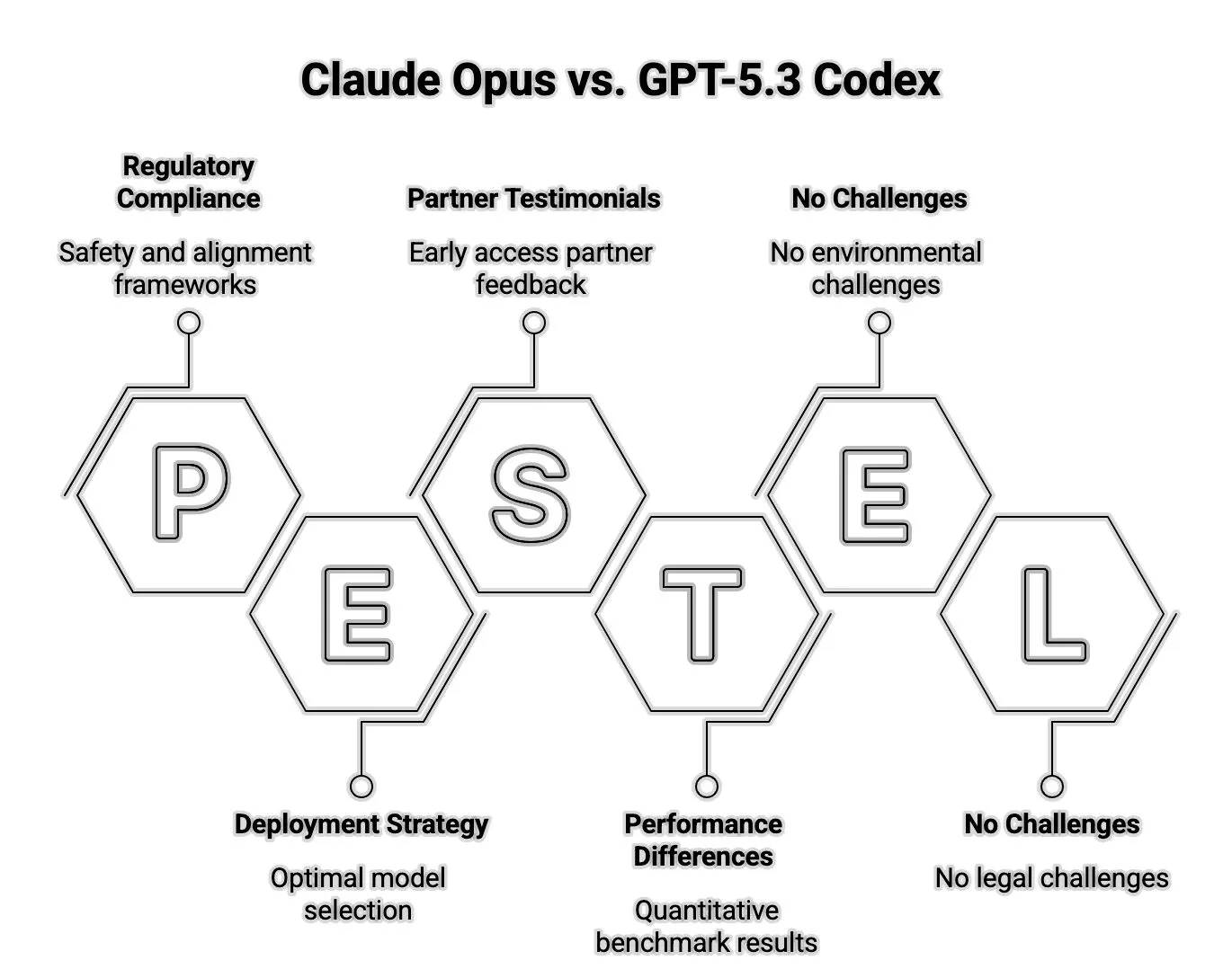
Abstract Abstract The February 2026 release of Anthropic's Claude Opus 4.6 and OpenAI's GPT-5.3 Codex represents the closest head-to-head launch window in frontier AI model history, with both models debuting within 24 hours of each other. This paper provides a comprehensive comparative analysis of these two flagship coding-focused language models across technical capabilities, benchmark performance, architectural approaches, safety frameworks, and deployment considerations. Our analysis reveals distinct strategic positioning: Claude Opus 4.6 prioritizes reasoning depth and long-context analysis with state-of-the-art performance on academic benchmarks (GPQA Diamond: 77.3%, MMLU Pro: 85.1%), while GPT-5.3 Codex emphasizes agentic speed and coding throughput with 25% faster inference and superior terminal automation capabilities (Terminal-Bench 2.0: 77.3%). Both models demonstrate significant advances in autonomous software engineering, though they employ divergent architectural philosophies—constitutional alignment versus ecosystem-level defenses—that have substantial implications for enterprise adoption. This research provides decision frameworks for organizations evaluating these models and identifies optimal use-case segmentation strategies for multi-model deployments. Introduction Introduction The February 2026 Frontier AI Release Event The February 2026 Frontier AI Release Event On February 4, 2026, Anthropic released Claude Opus 4.6, its most capable model to date, featuring enhanced coding skills, agentic task sustainability, and a breakthrough 1-million-token context window[1]. Within 24 hours, OpenAI responded with GPT-5.3 Codex on February 5, 2026, positioning it as a high-throughput coding engine optimized for autonomous software engineering[2]. This unprecedented release cadence reflects intensifying competition in the frontier AI space and marks a critical inflection point in enterprise AI adoption. The timing of these releases is significant for three reasons. First, both models represent flagship upgrades to their respective families, incorporating fundamental architectural innovations rather than incremental improvements. Second, the simultaneous launch creates a natural experiment for comparative evaluation, as both models target similar use cases with different technical approaches. Third, the releases signal a strategic shift from general-purpose language models toward specialized coding and agentic capabilities, reflecting market demand for AI systems that can autonomously complete complex software engineering tasks. Research Objectives Research Objectives This paper addresses four primary research questions: What are the quantitative performance differences between Claude Opus 4.6 and GPT-5.3 Codex across standardized benchmarks? How do architectural choices—reasoning depth versus inference speed, long-context windows versus computational efficiency affect practical deployment outcomes? What safety and alignment frameworks distinguish these models, and what implications do these frameworks have for regulated industries? Under what conditions should organizations choose one model over the other, and when does a multi-model deployment strategy provide optimal results? What are the quantitative performance differences between Claude Opus 4.6 and GPT-5.3 Codex across standardized benchmarks? How do architectural choices—reasoning depth versus inference speed, long-context windows versus computational efficiency affect practical deployment outcomes? What safety and alignment frameworks distinguish these models, and what implications do these frameworks have for regulated industries? Under what conditions should organizations choose one model over the other, and when does a multi-model deployment strategy provide optimal results? Our analysis draws on official benchmark results published by both companies, third-party evaluations, early access partner testimonials, and comparative testing on real-world coding tasks. Technical Architecture and Core Capabilities Technical Architecture and Core Capabilities Context Windows and Output Capacity Context Windows and Output Capacity Claude Opus 4.6 introduces a 1-million-token context window in beta, representing a 5× increase over standard production limits (200k tokens)[1]. This extended context enables whole-codebase analysis, multi-document synthesis, and long-horizon agentic tasks without chunking or retrieval augmentation. The model supports output sequences up to 128,000 tokens, allowing generation of complete documentation sets, large-scale refactors, or comprehensive reports in a single API call[1]. In contrast, GPT-5.3 Codex maintains a 400,000-token context window but optimizes for computational efficiency and inference speed rather than maximum context length[2]. OpenAI's architecture prioritizes rapid iteration in agentic loops over single-pass long-context processing. The 128,000-token output limit matches Claude, ensuring parity on large-output tasks[3]. Practical implications: For codebases exceeding 200,000 tokens or documentation projects requiring extensive synthesis, Claude's 1M context provides a structural advantage. For agentic workflows that make hundreds of short API calls with rapid feedback loops, GPT-5.3's optimized inference pipeline delivers better throughput. Practical implications: Reasoning and Planning Mechanisms Reasoning and Planning Mechanisms Claude Opus 4.6 introduces adaptive thinking, a configurable reasoning system that dynamically adjusts computational effort based on task complexity[1]. The system operates across four effort levels (low, medium, high, max) and allocates up to 128,000 tokens to internal reasoning chains before generating final outputs. This architecture enables the model to "think more deeply and carefully revisit its reasoning" before committing to answers[1]. adaptive thinking Internal testing by Anthropic engineers reveals that Opus 4.6 "brings more focus to the most challenging parts of a task without being told to, moves quickly through the more straightforward parts, handles ambiguous problems with better judgment, and stays productive over longer sessions"[1]. Early access partner Devin (Cognition AI) reported that Opus 4.6 "reasons through complex problems at a level we haven't seen before" and "considers edge cases that other models miss"[1]. GPT-5.3 Codex employs a different approach, optimizing for agentic speed rather than extended internal deliberation. The model achieves 25% faster inference compared to its predecessor (GPT-5.2 Codex) through architectural optimizations in the attention mechanism and more efficient token generation[2][3]. Rather than allocating large reasoning budgets before responding, GPT-5.3 emphasizes rapid hypothesis testing and iterative refinement through tool use and code execution. agentic speed OpenAI's design philosophy centers on self-bootstrapping sandboxes that allow the model to execute, validate, and debug code in tight feedback loops[2][3]. This approach reduces latency for long-running agentic tasks by minimizing the cost of individual reasoning steps while increasing the number of iterations per unit time. Performance trade-offs: Claude's adaptive thinking excels on tasks requiring deep analysis before action—architectural decisions, security audits, complex debugging. GPT-5.3's speed advantage becomes decisive when throughput matters more than deliberation—automated testing, large-scale refactors, high-volume code generation. Performance trade-offs: Agentic Task Persistence Agentic Task Persistence Both models introduce mechanisms for persistent agentic workflows, addressing a critical limitation of earlier systems: context exhaustion during long-running tasks. Claude Opus 4.6 implements context compaction, an API feature that automatically summarizes and replaces older conversation turns when approaching the context window limit[1]. This capability enables agents to operate continuously without manual checkpoint management or conversation resets. Compaction thresholds are configurable, allowing developers to balance compression aggressiveness against information retention. context compaction GPT-5.3 Codex supports agentic persistence through interactive steering, which allows developers to redirect agent behavior mid-task without losing accumulated context[2][3]. The model also reduces premature completion rates in flaky-test scenarios and long-horizon tasks, a persistent failure mode in earlier agentic systems[3]. interactive steering Anthropic reports that Opus 4.6 successfully "autonomously closed 13 issues and assigned 12 issues to the right team members in a single day, managing a ~50-person organization across 6 repositories"[1]. OpenAI emphasizes GPT-5.3's lower premature-completion rates and ability to maintain task coherence across hundreds of tool calls[2]. Benchmark Performance Analysis Benchmark Performance Analysis Coding Capabilities Coding Capabilities Benchmark Claude Opus 4.6 GPT-5.3 Codex Description SWE-bench Verified 79.4% — Real-world GitHub issues (Anthropic variant) SWE-bench Pro Public — 78.2% Enhanced difficulty tier (OpenAI variant) Terminal-Bench 2.0 65.4% 77.3% Command-line automation tasks OSWorld-Verified — 64.7% Desktop GUI automation TAU-bench (airline) 67.5% 61.2% Tool-augmented reasoning Benchmark Claude Opus 4.6 GPT-5.3 Codex Description SWE-bench Verified 79.4% — Real-world GitHub issues (Anthropic variant) SWE-bench Pro Public — 78.2% Enhanced difficulty tier (OpenAI variant) Terminal-Bench 2.0 65.4% 77.3% Command-line automation tasks OSWorld-Verified — 64.7% Desktop GUI automation TAU-bench (airline) 67.5% 61.2% Tool-augmented reasoning Benchmark Claude Opus 4.6 GPT-5.3 Codex Description Benchmark Benchmark Benchmark Claude Opus 4.6 Claude Opus 4.6 Claude Opus 4.6 GPT-5.3 Codex GPT-5.3 Codex GPT-5.3 Codex Description Description Description SWE-bench Verified 79.4% — Real-world GitHub issues (Anthropic variant) SWE-bench Verified SWE-bench Verified 79.4% 79.4% — — Real-world GitHub issues (Anthropic variant) Real-world GitHub issues (Anthropic variant) SWE-bench Pro Public — 78.2% Enhanced difficulty tier (OpenAI variant) SWE-bench Pro Public SWE-bench Pro Public — — 78.2% 78.2% Enhanced difficulty tier (OpenAI variant) Enhanced difficulty tier (OpenAI variant) Terminal-Bench 2.0 65.4% 77.3% Command-line automation tasks Terminal-Bench 2.0 Terminal-Bench 2.0 65.4% 65.4% 77.3% 77.3% Command-line automation tasks Command-line automation tasks OSWorld-Verified — 64.7% Desktop GUI automation OSWorld-Verified OSWorld-Verified — — 64.7% 64.7% Desktop GUI automation Desktop GUI automation TAU-bench (airline) 67.5% 61.2% Tool-augmented reasoning TAU-bench (airline) TAU-bench (airline) 67.5% 67.5% 61.2% 61.2% Tool-augmented reasoning Tool-augmented reasoning Table 1: Coding and agentic benchmark comparison Critical methodological note: Anthropic reports SWE-bench Verified scores while OpenAI reports SWE-bench Pro Public scores. These are distinct benchmark variants with different problem sets and difficulty distributions. Direct numerical comparison across variants is methodologically invalid[3]. Critical methodological note: Despite this limitation, directional patterns emerge. Claude Opus 4.6 demonstrates superior performance on tasks requiring reasoning and planning before execution (TAU-bench), while GPT-5.3 Codex dominates terminal automation and computer-use workflows (Terminal-Bench, OSWorld). Both models achieve scores near 80% on their respective SWE-bench variants, representing state-of-the-art performance on autonomous coding tasks. Reasoning and Knowledge Benchmarks Reasoning and Knowledge Benchmarks Benchmark Claude Opus 4.6 GPT-5.3 Codex Description GPQA Diamond 77.3% 73.8% Graduate-level STEM reasoning MMLU Pro 85.1% 82.9% Expert knowledge across domains Humanity's Last Exam 78.6% — Complex multidisciplinary reasoning GDPval-AA (Elo) 1606 — Economic reasoning tasks BigLaw Bench 90.2% — Legal reasoning and analysis Benchmark Claude Opus 4.6 GPT-5.3 Codex Description GPQA Diamond 77.3% 73.8% Graduate-level STEM reasoning MMLU Pro 85.1% 82.9% Expert knowledge across domains Humanity's Last Exam 78.6% — Complex multidisciplinary reasoning GDPval-AA (Elo) 1606 — Economic reasoning tasks BigLaw Bench 90.2% — Legal reasoning and analysis Benchmark Claude Opus 4.6 GPT-5.3 Codex Description Benchmark Benchmark Benchmark Claude Opus 4.6 Claude Opus 4.6 Claude Opus 4.6 GPT-5.3 Codex GPT-5.3 Codex GPT-5.3 Codex Description Description Description GPQA Diamond 77.3% 73.8% Graduate-level STEM reasoning GPQA Diamond GPQA Diamond 77.3% 77.3% 73.8% 73.8% Graduate-level STEM reasoning Graduate-level STEM reasoning MMLU Pro 85.1% 82.9% Expert knowledge across domains MMLU Pro MMLU Pro 85.1% 85.1% 82.9% 82.9% Expert knowledge across domains Expert knowledge across domains Humanity's Last Exam 78.6% — Complex multidisciplinary reasoning Humanity's Last Exam Humanity's Last Exam 78.6% 78.6% — — Complex multidisciplinary reasoning Complex multidisciplinary reasoning GDPval-AA (Elo) 1606 — Economic reasoning tasks GDPval-AA (Elo) GDPval-AA (Elo) 1606 1606 — — Economic reasoning tasks Economic reasoning tasks BigLaw Bench 90.2% — Legal reasoning and analysis BigLaw Bench BigLaw Bench 90.2% 90.2% — — Legal reasoning and analysis Legal reasoning and analysis Table 2: Reasoning and knowledge benchmark comparison Claude Opus 4.6 establishes clear leadership on reasoning-heavy academic and professional benchmarks. The 3.5-percentage-point advantage on GPQA Diamond (graduate-level physics, chemistry, and biology questions) and 2.2-point lead on MMLU Pro represent statistically significant improvements over GPT-5.3 Codex[1][3]. Anthropic reports that on GDPval-AA—an evaluation of economically valuable knowledge work across finance, legal, and other professional domains—Opus 4.6 outperforms GPT-5.2 (OpenAI's previous best model on this benchmark) by approximately 144 Elo points, translating to a win rate of approximately 70%[1]. This differential suggests substantial practical advantages for consulting, financial analysis, and legal research applications. Long-Context Retrieval Long-Context Retrieval A persistent challenge in large-context language models is "context rot"—performance degradation as conversation length increases. Claude Opus 4.6 addresses this limitation through architectural improvements in attention mechanisms and information retrieval. On the 8-needle 1M variant of MRCR v2 (a needle-in-a-haystack benchmark testing retrieval of information hidden in vast text corpora), Opus 4.6 scores 76%, compared to just 18.5% for its predecessor, Claude Sonnet 4.5[1]. This represents a qualitative shift in usable context length, enabling applications that require tracking details across millions of tokens. Anthropic partner Box reported that Opus 4.6 "excels in high-reasoning tasks like multi-source analysis across legal, financial, and technical content," with a 10% performance lift reaching 68% accuracy versus a 58% baseline[1]. Ross Intelligence noted that Opus 4.6 "represents a meaningful leap in long-context performance" with improved consistency across large information bodies[1]. Safety and Alignment Frameworks Safety and Alignment Frameworks Anthropic's Constitutional AI Approach Anthropic's Constitutional AI Approach Claude Opus 4.6 implements Constitutional AI v3, Anthropic's third-generation alignment framework[1]. The system employs automated behavioral audits across multiple risk dimensions, including: Deception detection (self-exfiltration attempts, hidden reasoning, misleading outputs) Sycophancy reduction (excessive agreement, user-delusion reinforcement) Misuse cooperation resistance (dual-use capabilities, dangerous request compliance) Over-refusal minimization (false-positive safety triggers on benign queries) Deception detection (self-exfiltration attempts, hidden reasoning, misleading outputs) Sycophancy reduction (excessive agreement, user-delusion reinforcement) Misuse cooperation resistance (dual-use capabilities, dangerous request compliance) Over-refusal minimization (false-positive safety triggers on benign queries) Anthropic reports that Opus 4.6 shows "low rates of misaligned behaviors" and achieves "the lowest rate of over-refusals of any recent Claude model"[1]. The company conducted "the most comprehensive set of safety evaluations of any model," including new assessments for user wellbeing, complex refusal testing, and interpretability methods to understand internal model behavior[1]. For cybersecurity capabilities—where Opus 4.6 shows "enhanced abilities" that could be misused—Anthropic developed six new probes to track different forms of potential abuse[1]. The company simultaneously accelerated defensive applications, using the model to find and patch vulnerabilities in open-source software[1]. OpenAI's Preparedness Framework OpenAI's Preparedness Framework GPT-5.3 Codex represents the first model classified as "High" for cybersecurity risk under OpenAI's Preparedness Framework, requiring enhanced deployment safeguards[2]. OpenAI's approach emphasizes structured deployment gates and ecosystem-level defenses rather than internal constitutional constraints. The framework operates through tiered risk classification (Low, Medium, High, Critical) across four risk categories: cybersecurity, CBRN (chemical, biological, radiological, nuclear), persuasion, and model autonomy[2]. High-risk classifications trigger mandatory mitigations, including real-time intervention systems, usage monitoring, and restricted access controls. OpenAI has not yet published the detailed safety evaluation results for GPT-5.3 Codex equivalent to Anthropic's system card for Opus 4.6, making direct safety comparison difficult. However, the High cybersecurity classification indicates that OpenAI's internal red-teaming identified capabilities that could significantly assist offensive cyber operations if unrestricted[2]. Comparative Safety Philosophy Comparative Safety Philosophy Anthropic's constitutional approach embeds alignment constraints directly into model behavior through training and reinforcement learning from AI feedback. This creates inherent safety properties that persist across deployment contexts. The trade-off is potential capability degradation on edge-case inputs where safety constraints trigger inappropriately. OpenAI's preparedness framework treats safety as a deployment property rather than a model property, enabling fine-grained control through external systems. This allows higher raw capability at the model level while shifting safety responsibilities to the platform layer. The trade-off is dependence on infrastructure reliability and potential bypass vulnerabilities in the safety wrapper. For regulated industries (healthcare, finance, legal), Anthropic's documented low misalignment rates and comprehensive system card provide clearer audit trails. For organizations with mature AI governance and custom safety requirements, OpenAI's external control mechanisms offer greater flexibility. Pricing and Deployment Economics Pricing and Deployment Economics API Pricing Models API Pricing Models Pricing Dimension Claude Opus 4.6 GPT-5.3 Codex Input tokens (standard) $5 / million Pending Output tokens (standard) $25 / million Pending Input tokens (premium) $10 / million — Output tokens (premium) $37.50 / million — Prompt caching $1.25 / million (75% off) TBD Context window 200k (1M beta) 400k Max output 128k tokens 128k tokens Pricing Dimension Claude Opus 4.6 GPT-5.3 Codex Input tokens (standard) $5 / million Pending Output tokens (standard) $25 / million Pending Input tokens (premium) $10 / million — Output tokens (premium) $37.50 / million — Prompt caching $1.25 / million (75% off) TBD Context window 200k (1M beta) 400k Max output 128k tokens 128k tokens Pricing Dimension Claude Opus 4.6 GPT-5.3 Codex Pricing Dimension Pricing Dimension Pricing Dimension Claude Opus 4.6 Claude Opus 4.6 Claude Opus 4.6 GPT-5.3 Codex GPT-5.3 Codex GPT-5.3 Codex Input tokens (standard) $5 / million Pending Input tokens (standard) Input tokens (standard) $5 / million $5 / million Pending Pending Output tokens (standard) $25 / million Pending Output tokens (standard) Output tokens (standard) $25 / million $25 / million Pending Pending Input tokens (premium) $10 / million — Input tokens (premium) Input tokens (premium) $10 / million $10 / million — — Output tokens (premium) $37.50 / million — Output tokens (premium) Output tokens (premium) $37.50 / million $37.50 / million — — Prompt caching $1.25 / million (75% off) TBD Prompt caching Prompt caching $1.25 / million (75% off) $1.25 / million (75% off) TBD TBD Context window 200k (1M beta) 400k Context window Context window 200k (1M beta) 200k (1M beta) 400k 400k Max output 128k tokens 128k tokens Max output Max output 128k tokens 128k tokens 128k tokens 128k tokens Table 3: API pricing comparison as of February 9, 2026 Claude Opus 4.6 pricing is fully transparent and available immediately. Standard pricing ($5 input / $25 output per million tokens) applies to prompts up to 200,000 tokens. Premium pricing ($10 input / $37.50 per million tokens) applies when using the 1-million-token beta context window[1]. Anthropic's prompt caching system offers 75% cost reduction on repeated content, reducing input costs to $1.25 per million cached tokens[1]. GPT-5.3 Codex API pricing remains unpublished as of February 9, 2026[3]. OpenAI announced that API access will become available "in the coming weeks" but has not provided cost estimates[2]. Current access is limited to ChatGPT Plus, Pro, Team, and Enterprise subscription tiers, with per-token API pricing expected at a later date. Cost modeling implications: Organizations planning February-March 2026 deployments can complete accurate cost projections for Claude Opus 4.6 but must estimate GPT-5.3 costs based on historical OpenAI pricing patterns. For budget-constrained projects, Claude's immediate pricing transparency reduces procurement uncertainty. Cost modeling implications: Inference Speed and Throughput Inference Speed and Throughput GPT-5.3 Codex delivers 25% faster inference than its predecessor, translating to approximately 33% higher throughput for equivalent token volumes[2][3]. For high-volume agentic workflows making thousands of API calls daily, this speed advantage compounds significantly. Consider a development team running 5,000 agentic coding tasks per day, each requiring 10 API calls with 500-token responses. At 25% faster inference: Claude Opus 4.6 baseline: ~240 seconds per task → 20,000 minutes daily GPT-5.3 Codex optimized: ~180 seconds per task → 15,000 minutes daily Net productivity gain: 5,000 minutes (83 hours) of latency reduction daily Claude Opus 4.6 baseline: ~240 seconds per task → 20,000 minutes daily GPT-5.3 Codex optimized: ~180 seconds per task → 15,000 minutes daily Net productivity gain: 5,000 minutes (83 hours) of latency reduction daily For latency-sensitive applications (IDE integrations, real-time code review), GPT-5.3's speed advantage translates directly to user experience improvements. For batch processing or analysis tasks where wall-clock time is less critical, Claude's reasoning depth may justify the additional latency. Deployment Decision Framework Deployment Decision Framework Selection Criteria by Use Case Selection Criteria by Use Case Use Case Category Preferred Model Rationale Graduate-level research, academic analysis Claude Opus 4.6 GPQA Diamond: 77.3% vs. 73.8%; MMLU Pro: 85.1% vs. 82.9% Long-context document analysis (>200k tokens) Claude Opus 4.6 1M context window enables whole-document processing Legal reasoning, contract analysis Claude Opus 4.6 BigLaw Bench: 90.2%; GDPval-AA economic reasoning: 1606 Elo High-volume agentic coding loops GPT-5.3 Codex 25% faster inference; lower premature completion rates Terminal automation, shell scripting GPT-5.3 Codex Terminal-Bench 2.0: 77.3% vs. 65.4% Desktop GUI automation GPT-5.3 Codex OSWorld-Verified: 64.7%; native computer-use capabilities Regulated industries (healthcare, finance) Claude Opus 4.6 Comprehensive system card; low misalignment rates; constitutional AI audit trail Existing OpenAI ecosystem integration GPT-5.3 Codex Native compatibility with Copilot, Azure OpenAI, ChatGPT Enterprise Use Case Category Preferred Model Rationale Graduate-level research, academic analysis Claude Opus 4.6 GPQA Diamond: 77.3% vs. 73.8%; MMLU Pro: 85.1% vs. 82.9% Long-context document analysis (>200k tokens) Claude Opus 4.6 1M context window enables whole-document processing Legal reasoning, contract analysis Claude Opus 4.6 BigLaw Bench: 90.2%; GDPval-AA economic reasoning: 1606 Elo High-volume agentic coding loops GPT-5.3 Codex 25% faster inference; lower premature completion rates Terminal automation, shell scripting GPT-5.3 Codex Terminal-Bench 2.0: 77.3% vs. 65.4% Desktop GUI automation GPT-5.3 Codex OSWorld-Verified: 64.7%; native computer-use capabilities Regulated industries (healthcare, finance) Claude Opus 4.6 Comprehensive system card; low misalignment rates; constitutional AI audit trail Existing OpenAI ecosystem integration GPT-5.3 Codex Native compatibility with Copilot, Azure OpenAI, ChatGPT Enterprise Use Case Category Preferred Model Rationale Use Case Category Use Case Category Use Case Category Preferred Model Preferred Model Preferred Model Rationale Rationale Rationale Graduate-level research, academic analysis Claude Opus 4.6 GPQA Diamond: 77.3% vs. 73.8%; MMLU Pro: 85.1% vs. 82.9% Graduate-level research, academic analysis Graduate-level research, academic analysis Claude Opus 4.6 Claude Opus 4.6 GPQA Diamond: 77.3% vs. 73.8%; MMLU Pro: 85.1% vs. 82.9% GPQA Diamond: 77.3% vs. 73.8%; MMLU Pro: 85.1% vs. 82.9% Long-context document analysis (>200k tokens) Claude Opus 4.6 1M context window enables whole-document processing Long-context document analysis (>200k tokens) Long-context document analysis (>200k tokens) Claude Opus 4.6 Claude Opus 4.6 1M context window enables whole-document processing 1M context window enables whole-document processing Legal reasoning, contract analysis Claude Opus 4.6 BigLaw Bench: 90.2%; GDPval-AA economic reasoning: 1606 Elo Legal reasoning, contract analysis Legal reasoning, contract analysis Claude Opus 4.6 Claude Opus 4.6 BigLaw Bench: 90.2%; GDPval-AA economic reasoning: 1606 Elo BigLaw Bench: 90.2%; GDPval-AA economic reasoning: 1606 Elo High-volume agentic coding loops GPT-5.3 Codex 25% faster inference; lower premature completion rates High-volume agentic coding loops High-volume agentic coding loops GPT-5.3 Codex GPT-5.3 Codex 25% faster inference; lower premature completion rates 25% faster inference; lower premature completion rates Terminal automation, shell scripting GPT-5.3 Codex Terminal-Bench 2.0: 77.3% vs. 65.4% Terminal automation, shell scripting Terminal automation, shell scripting GPT-5.3 Codex GPT-5.3 Codex Terminal-Bench 2.0: 77.3% vs. 65.4% Terminal-Bench 2.0: 77.3% vs. 65.4% Desktop GUI automation GPT-5.3 Codex OSWorld-Verified: 64.7%; native computer-use capabilities Desktop GUI automation Desktop GUI automation GPT-5.3 Codex GPT-5.3 Codex OSWorld-Verified: 64.7%; native computer-use capabilities OSWorld-Verified: 64.7%; native computer-use capabilities Regulated industries (healthcare, finance) Claude Opus 4.6 Comprehensive system card; low misalignment rates; constitutional AI audit trail Regulated industries (healthcare, finance) Regulated industries (healthcare, finance) Claude Opus 4.6 Claude Opus 4.6 Comprehensive system card; low misalignment rates; constitutional AI audit trail Comprehensive system card; low misalignment rates; constitutional AI audit trail Existing OpenAI ecosystem integration GPT-5.3 Codex Native compatibility with Copilot, Azure OpenAI, ChatGPT Enterprise Existing OpenAI ecosystem integration Existing OpenAI ecosystem integration GPT-5.3 Codex GPT-5.3 Codex Native compatibility with Copilot, Azure OpenAI, ChatGPT Enterprise Native compatibility with Copilot, Azure OpenAI, ChatGPT Enterprise Table 4: Model selection framework by use case Multi-Model Deployment Strategy Multi-Model Deployment Strategy For organizations with diverse AI workloads, a multi-model routing strategy can optimize for both performance and cost. The following architecture pattern demonstrates task-based model selection with automatic fallback: Routing Configuration Example: Routing Configuration Example: const MODEL_CONFIG = { reasoning: {model: "claude-opus-4-6", fallback: "gpt-5.3-codex", use: "GPQA-heavy analysis, long-context docs, legal reasoning", effortLevel: "high"}, coding: { model: "gpt-5.3-codex", fallback: "claude-opus-4-6", use: "Agentic loops, terminal tasks, large-scale refactors", maxRetries: 3 }, timeoutMs: 120000, telemetry: { trackAcceptanceRate: true, trackRerunsPerModel: true, trackReviewerEdits: true } }; const MODEL_CONFIG = { reasoning: {model: "claude-opus-4-6", fallback: "gpt-5.3-codex", use: "GPQA-heavy analysis, long-context docs, legal reasoning", effortLevel: "high"}, coding: { model: "gpt-5.3-codex", fallback: "claude-opus-4-6", use: "Agentic loops, terminal tasks, large-scale refactors", maxRetries: 3 }, timeoutMs: 120000, telemetry: { trackAcceptanceRate: true, trackRerunsPerModel: true, trackReviewerEdits: true } }; This configuration routes reasoning-intensive tasks (research synthesis, architectural decisions, complex debugging) to Claude Opus 4.6 while directing high-throughput coding tasks (automated testing, refactors, terminal automation) to GPT-5.3 Codex. Fallback mechanisms ensure reliability when the primary model is unavailable or rate-limited. Key observability metrics: Key observability metrics: Patch acceptance rate by model Average reruns required before approval Reviewer edit density (lines changed post-generation) End-to-end task completion time Cost per successful task completion Patch acceptance rate by model Average reruns required before approval Reviewer edit density (lines changed post-generation) End-to-end task completion time Cost per successful task completion Organizations should instrument these metrics during evaluation periods (30-90 days) to empirically validate model selection rather than relying solely on published benchmarks. Migration Guidance Migration Guidance From Claude Opus 4.5 to 4.6 From Claude Opus 4.5 to 4.6 Anthropic introduced several breaking changes that require code modifications: Response prefilling disabled: Claude 4.5 supported response prefilling to guide output format. This capability is removed in 4.6. Migrate to system prompt instructions or few-shot examples. Extended thinking replaced by adaptive thinking: API calls using extended_thinking: true must migrate to the new effort-level system (effort: "low" | "medium" | "high" | "max"). Context compaction opt-in: Long-running agentic tasks should enable compaction to prevent context exhaustion. Configure thresholds based on typical conversation lengths. Response prefilling disabled: Claude 4.5 supported response prefilling to guide output format. This capability is removed in 4.6. Migrate to system prompt instructions or few-shot examples. Response prefilling disabled: Extended thinking replaced by adaptive thinking: API calls using extended_thinking: true must migrate to the new effort-level system (effort: "low" | "medium" | "high" | "max"). Extended thinking replaced by adaptive thinking: Context compaction opt-in: Long-running agentic tasks should enable compaction to prevent context exhaustion. Configure thresholds based on typical conversation lengths. Context compaction opt-in: Testing recommendations: Run parallel deployments of 4.5 and 4.6 on production traffic samples (10-20% of volume) for 2-4 weeks to identify behavioral differences before full cutover. Testing recommendations: From GPT-5.2 Codex to 5.3 From GPT-5.2 Codex to 5.3 OpenAI has not yet published a migration guide for GPT-5.3 Codex as of February 9, 2026. Based on early access reports and the February 5 announcement, anticipated changes include: Faster default inference: 25% speed increase may affect timeout configurations and retry logic in existing agentic systems. Lower premature completion: Tasks that previously required explicit "continue" prompts may complete autonomously, potentially changing conversation flow. New deep-diff capabilities: Code review workflows can leverage enhanced diff explanations showing reasoning behind changes, not just the changes themselves. Faster default inference: 25% speed increase may affect timeout configurations and retry logic in existing agentic systems. Faster default inference: Lower premature completion: Tasks that previously required explicit "continue" prompts may complete autonomously, potentially changing conversation flow. Lower premature completion: New deep-diff capabilities: Code review workflows can leverage enhanced diff explanations showing reasoning behind changes, not just the changes themselves. New deep-diff capabilities: Organizations should maintain GPT-5.2 as a fallback option during the initial API rollout period, using feature flags or environment variables to control model routing while validating 5.3 behavior on internal codebases. Limitations and Future Research Directions Limitations and Future Research Directions Benchmark Validity and Generalization Benchmark Validity and Generalization A critical limitation of this analysis is the non-comparability of SWE-bench variants. Anthropic and OpenAI report scores on different benchmark subsets (Verified vs. Pro Public), making direct numerical comparison invalid. This fragmentation reflects broader challenges in AI evaluation: companies selectively report benchmarks where their models perform favorably, and benchmark saturation (scores approaching 100%) reduces discriminatory power. Future research should prioritize: Standardized evaluation protocols accepted across companies Domain-specific benchmarks for regulated industries (healthcare diagnostics, financial compliance, legal discovery) Long-term deployment studies tracking model performance on real engineering teams over months rather than synthetic benchmarks Standardized evaluation protocols accepted across companies Domain-specific benchmarks for regulated industries (healthcare diagnostics, financial compliance, legal discovery) Long-term deployment studies tracking model performance on real engineering teams over months rather than synthetic benchmarks Safety Evaluation Transparency Safety Evaluation Transparency While Anthropic published a comprehensive system card for Claude Opus 4.6[1], OpenAI has not released equivalent documentation for GPT-5.3 Codex as of February 9, 2026. This asymmetry limits rigorous safety comparison. The "High" cybersecurity classification suggests significant dual-use capabilities, but without detailed red-team reports, organizations cannot independently assess risk levels. The AI safety community requires standardized safety reporting frameworks analogous to Common Vulnerabilities and Exposures (CVE) systems in cybersecurity. Model cards should include: Quantified misalignment rates across behavioral categories Red-team success rates and exploitation vectors Deployment mitigation effectiveness data Incident response protocols and disclosure timelines Quantified misalignment rates across behavioral categories Red-team success rates and exploitation vectors Deployment mitigation effectiveness data Incident response protocols and disclosure timelines Economic Model Uncertainty Economic Model Uncertainty GPT-5.3 Codex pricing remains unpublished, preventing complete total-cost-of-ownership (TCO) analysis. Organizations evaluating these models in February-March 2026 face procurement uncertainty that may delay deployment decisions. OpenAI should prioritize API pricing transparency to enable enterprise planning. Additionally, neither company has published inference carbon emissions data, an increasingly important factor for organizations with sustainability commitments. Future model releases should include environmental impact assessments as standard practice. Conclusion Conclusion Claude Opus 4.6 and GPT-5.3 Codex represent distinct strategic visions for frontier AI development. Anthropic prioritizes reasoning depth, long-context capabilities, and constitutional alignment, producing a model optimized for high-stakes knowledge work where accuracy and judgment matter most. OpenAI emphasizes inference speed, agentic throughput, and ecosystem integration, creating a model designed for high-volume autonomous coding at scale. Neither model is universally superior. The optimal choice depends on workload characteristics, existing infrastructure, regulatory requirements, and organizational risk tolerance. For many enterprises, a multi-model routing strategy offers the best of both approaches: Claude for research, analysis, and regulatory applications; GPT-5.3 for coding automation, terminal workflows, and high-throughput tasks. As these models enter production deployment over the coming months, empirical performance data from real-world engineering teams will provide ground truth beyond synthetic benchmarks. Organizations should instrument telemetry from the outset, tracking acceptance rates, edit density, and task completion metrics to validate model selection decisions. The AI landscape continues to evolve rapidly; flexibility and evidence-based evaluation will remain critical success factors. References References [1] Anthropic. (2026, February 4). Introducing Claude Opus 4.6. Anthropic News. https://www.anthropic.com/news/claude-opus-4-6 Anthropic News https://www.anthropic.com/news/claude-opus-4-6 [2] OpenAI. (2026, February 5). OpenAI releases GPT-5.3-Codex. OpenAI Announcements. Retrieved from https://www.tomsguide.com/ai/i-tested-chatgpt-5-2-vs-claude-4-6-opus-in-9-tough-challenges-heres-the-winner OpenAI Announcements https://www.tomsguide.com/ai/i-tested-chatgpt-5-2-vs-claude-4-6-opus-in-9-tough-challenges-heres-the-winner [3] Digital Applied. (2026, February 4). Claude Opus 4.6 vs GPT-5.3 Codex: Complete comparison. Digital Applied Blog. https://www.digitalapplied.com/blog/claude-opus-4-6-vs-gpt-5-3-codex-comparison Digital Applied Blog https://www.digitalapplied.com/blog/claude-opus-4-6-vs-gpt-5-3-codex-comparison [4] eesel.ai. (2026, February 6). GPT 5.3 Codex vs Claude Opus 4.6: An overview of the new AI frontier. eesel.ai Blog. https://www.eesel.ai/blog/gpt-53-codex-vs-claude-opus-46 eesel.ai eesel.ai Blog eesel.ai https://www.eesel.ai/blog/gpt-53-codex-vs-claude-opus-46 [5] Trending Topics. (2026, February 8). Anthropic's Claude Opus 4.6 claims top spot in AI rankings, beating OpenAI and Google. Trending Topics EU. https://www.trendingtopics.eu/anthropics-claude-opus-4-6-claims-top-spot-in-ai-rankings-beating-openai-and-google/ Trending Topics EU https://www.trendingtopics.eu/anthropics-claude-opus-4-6-claims-top-spot-in-ai-rankings-beating-openai-and-google/ [6] CNBC. (2026, February 9). Sam Altman touts ChatGPT's reaccelerating growth as OpenAI closes in on $100 billion funding. CNBC Technology. https://www.cnbc.com/2026/02/09/sam-altman-touts-chatgpt-growth-as-openai-nears-100-billion-funding.html CNBC Technology https://www.cnbc.com/2026/02/09/sam-altman-touts-chatgpt-growth-as-openai-nears-100-billion-funding.html