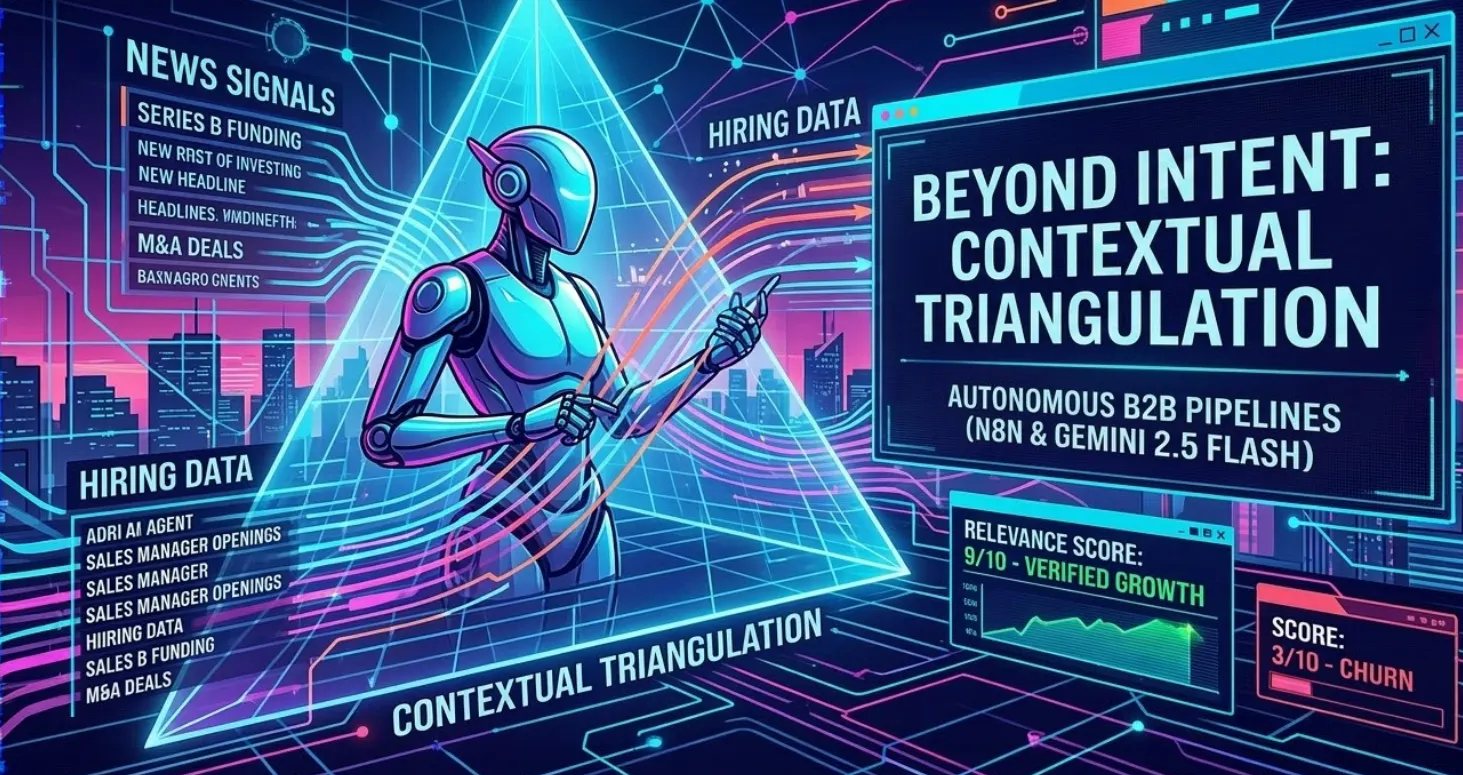
TL;DR: Mass AI outreach has reached a point of diminishing returns. This article breaks down a production-ready, event-driven SDR agentic pipeline using n8n and Gemini 2.5 Flash. We move beyond simple "personalisation" to Contextual Triangulation—a method of cross-referencing PR signals with recruitment data to distinguish genuine growth from internal churn, ensuring high-velocity outreach without sacrificing domain reputation. Contextual Triangulation The 2026 Outreach Paradox By now, every B2B growth team has access to LLMs. The result? A catastrophic influx of "pseudo-personalised" noise that has forced decision-makers to raise their filters. In this climate, "cheap" automation is actually expensive—it destroys deliverability and brand equity. To stay ahead, we must pivot from "Generative AI" (writing emails) to "Agentic Reasoning" (deciding if and why we should write). My current architecture focuses on a concept I call Contextual Triangulation. "Agentic Reasoning" if why Contextual Triangulation The Architecture: Event-Driven Intelligence Most SDR setups rely on batch processing, which is brittle and lacks nuance. Our pipeline is built on n8n as an orchestrator, treating every lead as an atomic, event-driven webhook. This allows for isolated error handling and massive parallelism. n8n 1. The Multi-Signal Intelligence Layer We don’t just scrape a LinkedIn profile. The agent initiates two concurrent search streams via Serper API: Serper API The News Hunter: Scans for funding rounds, M&A activity, or strategic pivots within the last six months. The Job Hunter: Analyses active recruitment data. The News Hunter: Scans for funding rounds, M&A activity, or strategic pivots within the last six months. The News Hunter: The Job Hunter: Analyses active recruitment data. The Job Hunter: 2. Contextual Triangulation: Growth vs. Churn This is the core "brain" of the agent. A linear bot sees 10 open Sales positions and assumes "Growth." A strategic agent triangulates: Scenario A (High Intent): 10 vacancies + a recent Series B announcement = Expansion. (The agent writes a "Scale" narrative). Scenario B (Low Intent): 10 vacancies + zero PR activity + listings older than 90 days = Churn or Stagnation. (The agent de-prioritises the lead). Scenario A (High Intent): 10 vacancies + a recent Series B announcement = Expansion. (The agent writes a "Scale" narrative). Scenario A (High Intent): Expansion Scenario B (Low Intent): 10 vacancies + zero PR activity + listings older than 90 days = Churn or Stagnation. (The agent de-prioritises the lead). Scenario B (Low Intent): Churn or Stagnation By calculating a Relevance Score (1-10), the system only proceeds if the score is <=7. This protects our "Token Thrift" and, more importantly, our sender reputation. Relevance Score (1-10) The Technical Bridge: Sanitisation and Schema Control Gemini 2.5 Flash is highly capable, but in a production pipeline, LLM "chatter" is a bug, not a feature. To ensure our BigQuery warehouse receives structured, predictable data, I use a robust JavaScript sanitisation layer within n8n. BigQuery /** * Post-LLM Sanitisation Script * Extracts valid JSON and enforces type-safety for BigQuery ingestion. */ const rawText = $node["Gemini_Intelligence"].json.content.parts[0].text; // Aggressive JSON boundary detection const start = rawText.indexOf('{'); const end = rawText.lastIndexOf('}'); if (start === -1 || end === -1) { return { relevance_score: 0.0, pain_category: "Parsing_Error", strategic_insight: "FAILED_TO_EXTRACT_JSON" }; } const jsonStr = rawText.substring(start, end + 1); try { const parsed = JSON.parse(jsonStr); return { icebreaker_en: parsed.icebreaker_en || "N/A", strategic_insight: parsed.strategic_insight || "N/A", // Force float for BigQuery schema alignment relevance_score: parseFloat(parsed.relevance_score) || 0.0, pain_category: parsed.pain_category || "General" }; } catch (e) { return { error: "Schema_Mismatch", raw: jsonStr.substring(0, 500) }; } /** * Post-LLM Sanitisation Script * Extracts valid JSON and enforces type-safety for BigQuery ingestion. */ const rawText = $node["Gemini_Intelligence"].json.content.parts[0].text; // Aggressive JSON boundary detection const start = rawText.indexOf('{'); const end = rawText.lastIndexOf('}'); if (start === -1 || end === -1) { return { relevance_score: 0.0, pain_category: "Parsing_Error", strategic_insight: "FAILED_TO_EXTRACT_JSON" }; } const jsonStr = rawText.substring(start, end + 1); try { const parsed = JSON.parse(jsonStr); return { icebreaker_en: parsed.icebreaker_en || "N/A", strategic_insight: parsed.strategic_insight || "N/A", // Force float for BigQuery schema alignment relevance_score: parseFloat(parsed.relevance_score) || 0.0, pain_category: parsed.pain_category || "General" }; } catch (e) { return { error: "Schema_Mismatch", raw: jsonStr.substring(0, 500) }; } Closing the Loop: The Reflection Step The most significant flaw in current AI GTM strategies is their linear nature. Our roadmap addresses this by transforming BigQuery from a passive data lake into a Feedback Hub. Feedback Hub The "Failure Audit" Workflow We are currently implementing a Reflection Step to close the loop: Reflection Step Ingestion: Outreach data (Replies vs. Bounces/Unsubscribes) is piped back to the database via webhooks. Weekly Reflection: A dedicated n8n workflow identifies leads with high Relevance Scores (>9) who did not engage. Model Critique: These data points are fed back to the model with a "Reflection Prompt": "Why did this insight fail to land? Was the tone too presumptuous or the timing misaligned?" Prompt Evolution: The system then generates Dynamic Optimization Notes that are injected into the primary agent's system instructions for the next cycle. Ingestion: Outreach data (Replies vs. Bounces/Unsubscribes) is piped back to the database via webhooks. Ingestion: Outreach data (Replies vs. Bounces/Unsubscribes) is piped back to the database via webhooks. Ingestion: Weekly Reflection: A dedicated n8n workflow identifies leads with high Relevance Scores (>9) who did not engage. Weekly Reflection: A dedicated n8n workflow identifies leads with high Relevance Scores (>9) who did not engage. Weekly Reflection: Model Critique: These data points are fed back to the model with a "Reflection Prompt": "Why did this insight fail to land? Was the tone too presumptuous or the timing misaligned?" Model Critique: These data points are fed back to the model with a "Reflection Prompt": "Why did this insight fail to land? Was the tone too presumptuous or the timing misaligned?" Model Critique: "Why did this insight fail to land? Was the tone too presumptuous or the timing misaligned?" Prompt Evolution: The system then generates Dynamic Optimization Notes that are injected into the primary agent's system instructions for the next cycle. Prompt Evolution: The system then generates Dynamic Optimization Notes that are injected into the primary agent's system instructions for the next cycle. Prompt Evolution: Dynamic Optimization Notes Results and RevOps Impact By moving to this agentic model, we've shifted the focus from Volume to Velocity. Volume Velocity Efficiency: Automating the "Senior SDR Intuition" saves approximately 35 hours of manual research per week. Cost-Effectiveness: At roughly $0.01 per lead for the entire intelligence stack, the ROI compared to a manual SDR team is exponential. Sanitised Scaling: Our database remains clean, our insights remain sharp, and our outreach remains human-centric. Efficiency: Automating the "Senior SDR Intuition" saves approximately 35 hours of manual research per week. Efficiency: Cost-Effectiveness: At roughly $0.01 per lead for the entire intelligence stack, the ROI compared to a manual SDR team is exponential. Cost-Effectiveness: $0.01 per lead Sanitised Scaling: Our database remains clean, our insights remain sharp, and our outreach remains human-centric. Sanitised Scaling: In 2026, the best "AI" doesn't look like AI—it looks like a well-informed peer.