
If you subscribe to tech newsletters, your inbox probably looks like a barrage emails about automating yourself, replacing teams with 20 agents, automating your life, and making yourself 100x more efficient.
There’s a distinct misery to being a consumer drowning in an everywhere-now sales pitch on productivity that’s intended for corporations. The enterprise case for AI is straightforward: companies need productivity gains, buyers need ROI, which makes for a coherent story. But simultaneously, it's being sold to individuals as if we're all just small companies optimizing for throughput, a story that doesn't match how humans actually look for meaning. Contributing to the dystopian image is an internet sloshing with AI generated slop, a result of turning that efficiency onto behaviors once meant exclusively for self-expression: content creation, amassing followers, social media interaction.
So the average person is left feeling dehumanized and asking: who actually benefits? The AI-everywhere conversation is a turn-off because it misses the point: technology alone has never determined how we organize work and leisure and meaning and how our lives really “feel”. It’s unsurprising that 80%+ of Americans are either equally or more concerned about AI than they are excited; it would be surprising if the stats were reversed!
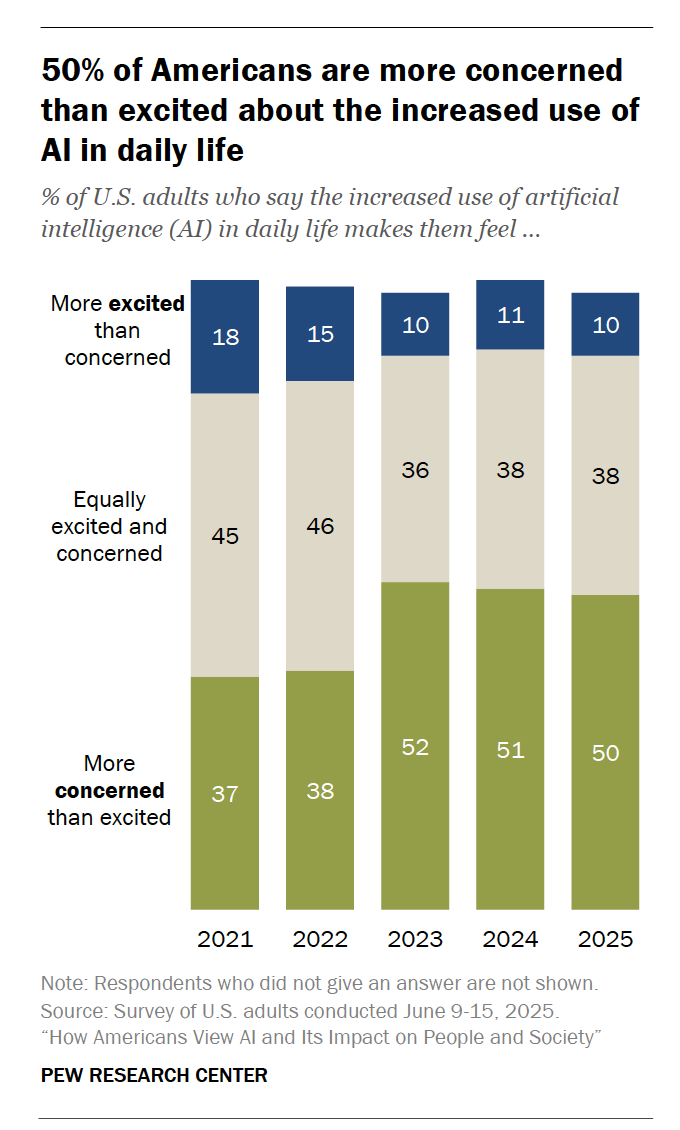
The result is a strobe-lights-flashing game of musical chairs, everyone scrambling to find an AI-proof career, financial independence, some sense of secure position, before the music stops. It feels as if there’s an inevitable cliff coming and we’ll all fall off of it, the only way to survive it is to lean in; resistance to AI-ification of everything is futile. Sacasas called this the Borg complex already in 2013, when similar claims were being made about other technologies. Seeing enough of them shows that nothing is inevitable, and the opportunity never predetermined or scarce.
Jevons paradox makes creativity cheap
When a price of a process drops, the result is often an abundance of hard-to-predict, second-order effects.
Conventional thinking in 1800s Britain assumed that if one could burn coal more efficiently - say, use 20% less for the same amount of energy output - Britain would save coal, and stretch its resources. Jevons disagreed: higher efficiency changes it from being a luxury to a low-cost input, which can sprout entirely new industries. The price of an output drops, triggering a (sometimes massive) increase in demand, and suddenly many cheaper use cases are unlocked. We’ve seen it happen repeatedly in tech:
- Cloud computing - which allowed a tech company split server usage, in theory decreasing how many servers were needed in the industry - didn’t lead to less demand for servers; it made compute so cheap that it sprouted digital lives that consume vastly more.
- AI x energy consumption: demand for data centers is skyrocketing despite models becoming more and more efficient.
Another phenomenon: when the process becomes more efficient, every hour it’s not running is money wasted. Tina He described this recently in her essay on AI making us more frenetic, not less: “when an hour of work generates what once took days, rest becomes luxury taxed by your own conscience. Every pause carries an invisible price tag that flickers in your peripheral vision.”
This makes sense at an industrial level. On an individual level, it leaves a choice: look at the surplus as space for more creativity and abundance, not productivity linearly measured its cash output.
When cost barriers collapse
One uniquely technological and social example of creativity is the Weird Internet of 90s and 00s. It got drowned out eventually, when the opportunity cost of dedicating engineering time to useless (i.e. without a direct line to revenue) ideas became too high. Making a web app in 2020 required a spec and hiring a freelance engineer for thousands of dollars; in 2025, it requires an evening with an LLM.
It’s easier to write a book today than it was 5 years ago not because the LLM can spit out books (nobody wants to read that), but because research and character development are dramatically easier.
It’s easier to skill up as a painter or sculptor because AI can generate hundreds of visuals to study anatomy, perspective, and composition.
The entrance fee for creative play has fallen, and it won’t all be for slop. Humans have an insatiable desire for deep pleasures that slop doesn’t satisfy. The question isn’t whether AI will kill art, but whether we can look past productivity to see what happens when everybody has a chance to act on the cheap creativity. You can reskin your apps to feed Windows XP nostalgia. You can build a pal that has no knowledge of the world past the 1800s. You can make a movie based on your dreams. You can build any retro game you want. If there’s a simple, weird toy you wish existed, you can build it in an evening.
I set out to look for my own breakthrough with claude code, unconvinced about the selling point of “becoming 100x more efficient”. I turned it onto my hobbies rather than strict work. I built a script that combs through hundreds of note files to find connected ideas to spark an essay. I built an editable UI simulation of an app I use. An English-to-Polish flash game to show to my toddler. None of these tools make me “productive” in a measurable way. But I still had my mind-blowing moment: the accessibility of throwaway, fun experiments. That is the cultural shift: the ability to build one random, niche idea after another, decide whether to discard it or share it; it doesn’t matter, it took 15 minutes to make. You don’t have to pre-judge them.
In pursuit of creative and fulfilling lives
In 1932, at the height of the Great Depression, Bertrand Russell published In Praise of Idleness. He was living through what resembles our worst-case AI fears: overproduction in amazingly efficient factories, starvation due to unemployment, and a government unable to solve the problem*.
“Modern methods of production have given us ease and security; we chose overwork and starvation instead”
Russell pointed out something eerily familiar: there’s an appetite for working less and living more, it’s theoretically possible with our technology, but individually we have no control over what the economy demands from us. Almost 100 years later, technology has delivered more output per hour, but not fewer hours. Any efficiency gets absorbed into more work, not more life.
Not for the lack of promises! That technology will free us from toil, give us meaningful work, let us pursue fulfillment: 1930s, Keynes predicted a 15-hour workweek. 1890s, Wilde imagined machines doing all labor while humans became artists. 1960s, Time Magazine told readers that by 2000 the machine-produced abundance would be so extreme that families wouldn’t need to work at all.
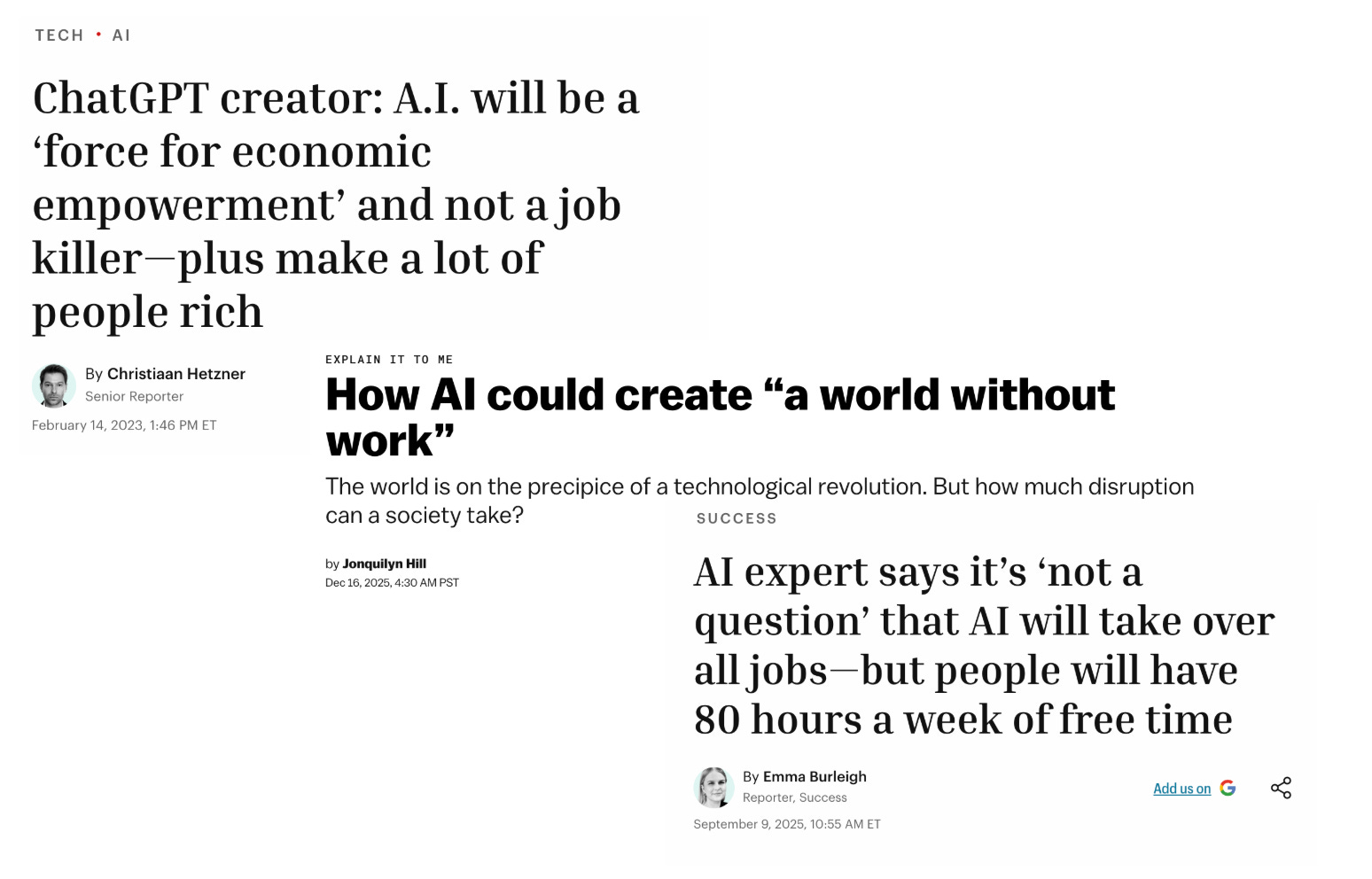
This is discouraging: that leisure and creativity are not permissionless, and they’re gated by economic demands we have no control over. Setting the societal level aside, something material did change on an individual level: the entrance fee has disappeared.
In 1932 Russell could describe the appetite for creative work, but the tools to act on it were gated by training, access, and cost. In 90s and 00s, the Weird Internet proved that if you increase access even a little, people make wonderful things until the cost barrier went back up; now it’s gone.
This is not the leisure utopia: economy still makes its demands, productivity will stay to be the dominant story, and the amount of slop will increase. But it’s up to us to participate in the right things. Adam Mastroianni writes that culture isn’t something that happens to us, but something we make:
“If you don’t like how culture is going, that’s a huge opportunity, because culture is us. You can move the needle just by showing up to the places you like to be, posting and promoting the kind of stuff you’d like to see, ignoring the things you don’t like, and vacating the places you think are bad.”
What we do with that is not an economics question. It’s a creative one.
PS. I write on Substack on tech and culture and would love to send these to you directly: kamilas.substack.com
Footnote
“Overproduction in amazingly efficient factories, starvation due to unemployment, and a government unable to solve the problem”: Factories and agriculture became incredibly efficient, causing millions of people to go unemployed. UK was in a deflationary spiral of overproduction and a poor society unable to absorb it. British government was artificially reducing supply of crops to prevent prices from collapsing, all while Hunger Marches were taking place. Political ideologies rising across Europe worshipped a worker who gave up individualism for output. WWI had shown that it’s possible to drastically reduce the “day-to-day” labor (redirecting it to war) while keeping everyone fed.